On this page
- Mines at a glance for Ghanaian players
- Playing a round from first tap to cash out
- Counting the chance of a safe tile
- Why the multipliers look the way they do
- What a GH₵10 bet returns at common settings
- Matching the mine count to your session
- Provably fair and how to check a board
- Bankroll, data drops and the rules in Ghana
- Getting value from the free demo
- Mines free demo
- Questions from players in Ghana
Mines at a glance for Ghanaian players
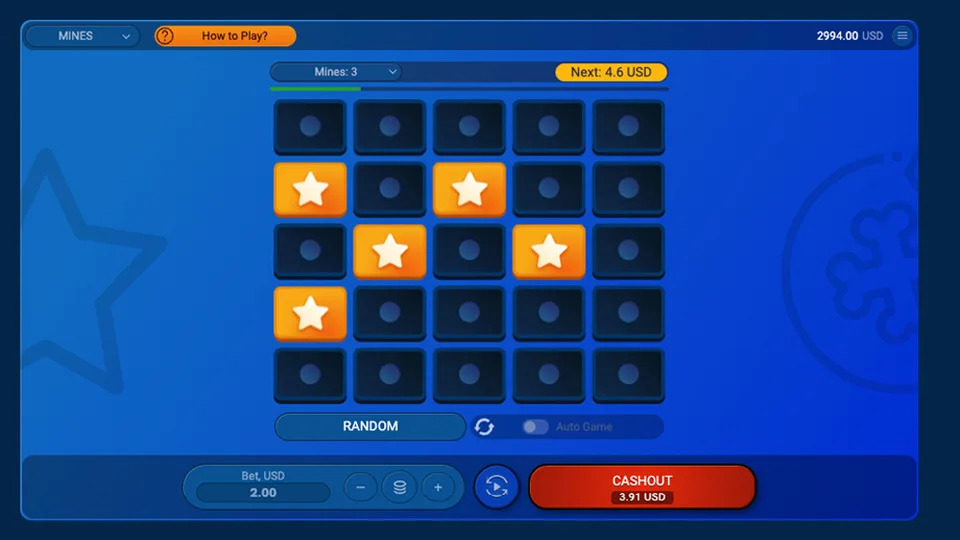
Mines comes from Spribe's Turbo range, a set of quick single-player titles sharing the provably fair technology behind Spribe's well-known crash title. If you ever clicked through the old minesweeper puzzle on an office computer, the idea will click at once. The board is a block of closed tiles. Some hide stars, some hide mines. Every star you uncover lifts the payout multiplier, while a mine finishes the round and swallows the stake.
There is no countdown and no shared round with other players. Nothing flies away while you think. The board waits for you, which means the only pressure is the pressure you put on yourself. You can tap a tile, take a breath, read the multiplier and decide calmly whether to stop.
Spribe gives the return to player as 97%, and the game rules name 5,044,291x as the maximum winning odds. What you can actually collect is capped by the operator, and that figure sits in the Game Limits section. Our RTP explainer covers what a 97% return means across thousands of rounds.
Playing a round from first tap to cash out
- Enter your bet. Tap a preset chip or type an amount such as GH₵5.
- Set the mines. The dropdown decides how many mines sit on the board. The rules say this changes both the odds and the bet multiplier, and the paytable inside the game lists values for 1 up to 20 mines.
- Press start. The mine positions get fixed right here by the provably fair system, so nothing can move once you begin clicking.
- Uncover tiles. Tap any tile you like, or use Pick randomly if you would rather the game chose. A star adds to the multiplier. A mine closes the round.
- Decide. After each star, Cash out hands you the bet multiplied by the figure currently displayed. Ignore it and you keep digging.
- See the board. Once the round is over, every tile flips open and the result is ready for a fairness check.
Counting the chance of a safe tile
You do not need a calculator app to understand Mines. No tile is luckier than another; a mine is equally likely under any closed square, so the odds come down to plain counting. On the 25-tile board with 3 mines, 22 tiles are stars. Your first tap is safe 88% of the time. Clear two in a row and you have beaten roughly 77% odds, three in a row about 67%, four about 58% and five close to a coin flip at 50%. Each new tap is slightly harder than the last, because the safe tiles run out while the mines stay put.
Raise the mine count and those numbers fall quickly. With 12 mines, only 13 tiles out of 25 are stars, so the very first tap is safe about 52% of the time. Push it to 24 mines and the board holds a single star. The dropdown works as your volatility knob. A few mines give you a steady trotro ride of small steps, many mines give rare and sharp jumps.
Why the multipliers look the way they do
In a perfectly fair game, the payout for reaching any point is simply the inverse of your odds of getting there. Mines takes that fair figure and pays 97% of it. With 3 mines, one star is fair at 25 divided by 22, about 1.136, and the game pays about 1.10x. Three stars are fair at around 1.49 and pay about 1.45x.
The same rule explains the headline number. The richest possible round uses 12 or 13 mines with every star uncovered. There are 5,200,300 ways to lay out such a board, and 97% of 5,200,300 is 5,044,291, exactly the maximum winning odds in Spribe's rules. Use our numbers to understand the logic, then trust the paytable inside your version of the game for the exact values.
What a GH₵10 bet returns at common settings
| Mines on board | Stars uncovered | Approx. multiplier | Cash out on GH₵10 | Chance of getting there |
|---|---|---|---|---|
| 1 | 5 | 1.21x | GH₵12.10 | 80% |
| 3 | 3 | 1.45x | GH₵14.50 | about 67% |
| 3 | 5 | 1.96x | GH₵19.60 | about 50% |
| 5 | 4 | 2.53x | GH₵25.30 | about 38% |
| 10 | 5 | 17.16x | GH₵171.60 | about 5.7% |
Read the last column alongside the payout. Doubling your GH₵10 at 3 mines and five stars works roughly one round in two. The GH₵171.60 line with 10 mines looks lovely, yet fewer than six rounds in a hundred get there. Every bigger number on this board is bought with a smaller chance.
Keep one more thing in mind. A mine does not cost you only the profit showing on screen. If you sat on 1.96x with a GH₵10 stake and tapped a mine, the GH₵19.60 did not shrink to GH₵10. The whole bet is gone.
Matching the mine count to your session
Since the long-run return is the same for every setting, the mine count is really a question of temperament. Three rough bands help:
- Light board, 1 to 3 mines. Most taps land on stars and each one adds a small step. It suits long, relaxed sessions and learning the buttons, but a decent win needs many stars in a row.
- Middle board, 4 to 8 mines. Three stars already pay a noticeable multiple, and your first tap is still more likely safe than not.
- Heavy board, 10 mines and above. Each tap is around even money or worse, while a short run of stars can multiply the stake several times over. Losing runs will be long, so the stake should be small enough to survive them.
Pick one band for the evening and stay there. Jumping to a heavier board to win back a loss is just a doubling plan wearing different clothes.
Provably fair and how to check a board
Spribe does not hide results behind a private server roll. The operator generates a server seed and shows you its hashed form before the round, which means it cannot be quietly changed later. Your browser supplies a client seed, and you can change it in the Provably Fair settings whenever you like. Both seeds feed a SHA512 hash, and Mines turns that hash into the coordinates of the mines.
To test a finished round, open bet records from the menu and tap the provably fair icon. You will see both seeds, the joint hash and the board that came out of them. This is also the clearest answer to anyone selling "Mines signals" on WhatsApp or Telegram. The layout comes from seeds you cannot see in advance, so no paid group or predictor app can know it. Those groups are scams that earn from subscriptions, not from winning.
Bankroll, data drops and the rules in Ghana
The 3% edge stays the same whatever board you choose and whenever you cash out. Over a long run, around GH₵97 comes back for every GH₵100 wagered. Doubling after losses does not fix that. Start at GH₵5 on an even-chance target and lose five times: GH₵5, GH₵10, GH₵20, GH₵40 and GH₵80 make GH₵155 gone, and the sixth bet must be GH₵160 just to finish GH₵5 ahead. Table limits and your MoMo wallet usually end the chain first.
A calmer routine is to set the mine count and the cash-out tile before you press start. Say you play 3 mines and always collect after the third star; that gives about two chances in three of collecting roughly 1.45x.
Mines also has an Auto Game mode. You mark the tiles you want, open Auto Play, set the number of rounds and your stop rules, and the same tiles are played each round with a counter you can tap to stop. Some operators switch autoplay off, as the rules mention. If your data bundle dies mid-round, the rules promise an automatic cash out at whatever multiplier was showing, with the win credited to you. Should the game itself malfunction, every bet and payout touched by it is voided and the stakes go back to players.
In Ghana, the Gaming Commission of Ghana licenses casinos, sports betting and online operators under the Gaming Act 2006 (Act 721). Play only if you are 18 or older, and expect a licensed operator to verify you with your Ghana Card. Our guides to online casinos in Ghana and MoMo deposits cover the money side.
Getting value from the free demo
What loads here is Spribe's own build running on play money, so nothing leaves your wallet. Our demo guide explains how to practise with a purpose. A good drill: open the paytable for two mine counts you like, compare its numbers with the table above, then play 30 rounds with one fixed cash-out rule and count how often you reach it.
When you move to a real-money version, read the RTP line and the Game Limits page before your first bet, because the maximum win there is the true ceiling. If you enjoy this format, Spribe's Plinko is another quick instant title, while Aviator moves you into shared rounds against the clock.
Where to play Mines with cedis

Questions from players in Ghana
How much does Mines pay back over time?
The provider quotes a 97% RTP. Think of it as a long-term average across huge volumes of play, covering every mine setting and cash-out point. Changing the mine count changes how bumpy your results are, not the average you get back.
How many mines can I set on the board?
You choose the number from a dropdown before you start, and the paytable inside the game lists values for boards with 1 through 20 mines. More mines make each safe tile less likely and each star worth more.
How big can a single Mines win get?
Spribe's rules quote maximum winning odds of 5,044,291x. Your real ceiling is the operator's win limit, which you will find under Game Limits in the game menu before you place a bet.
When am I allowed to cash out?
After any star. Tap Cash out and you receive your bet times the multiplier on screen, so GH₵10 at 1.45x pays GH₵14.50. Tap a mine first and the full bet is lost.
Can a Telegram or WhatsApp group predict where the mines are?
No. Mine positions come from a hashed server seed fixed before the round and your own client seed. Nobody outside can see them in advance, so paid signal and predictor groups are scams that profit from your subscription.
How likely is my first tap to be safe?
It depends on the board. With 3 mines among 25 tiles, 22 are stars, giving an 88% chance on the opening tap. Load 12 mines and it slides to about 52%.
Is Mines legal to play in Ghana?
The Gaming Commission of Ghana licenses casinos and online operators under the Gaming Act 2006 (Act 721). You must be 18 or older, and licensed operators check your identity with the Ghana Card.