On this page
- What kind of game Mines is
- A round, click by click
- Why the mine total changes everything
- How each multiplier is built
- Rupee payouts for common settings
- Choosing a setting for your style
- The provably fair check
- Managing money and the progression myth
- Autoplay and the remaining rules
- The position in India
- Using the free demo well
- Mines free demo
- Frequently asked questions
What kind of game Mines is
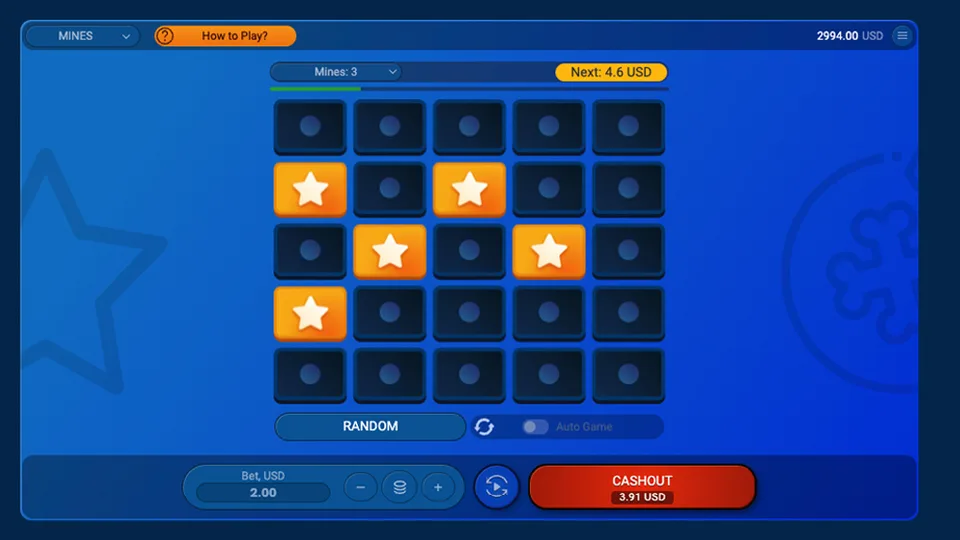
Spribe files Mines under its Turbo collection, a set of fast solo games powered by the same provably fair system the studio uses for its crash title Aviator. If you ever played Minesweeper on an old office PC, the idea needs no introduction: closed squares on a board conceal either stars or mines. A star lifts the multiplier on your bet, and a mine closes the round and keeps the stake.
Unlike a crash game, nothing here happens without you. No plane is climbing away and no timer runs down. You click the next square whenever you feel ready, you can quit at any point, and the cash-out option is there after every successful pick. So Mines comes down to self-control: all the numbers are visible, and the only decision is how deep you go.
Spribe gives a return to player of 97%, and its rules set the highest winning odds at 5,044,291x, although each casino caps the actual maximum payout. Read our guide to RTP for what that 97% really means across a large number of rounds.
A round, click by click
- Enter your bet. Use one of the quick amounts or key in a figure of your own, say ₹100.
- Set the mine total. This sits in a dropdown. The rules state that it alters both the odds and the multiplier, and the paytable inside the game covers every setting from 1 up to 20 mines.
- Begin. The moment the round starts, the provably fair system locks in the mine positions.
- Reveal squares. Click whichever square you want, or hit Pick randomly and let the game decide. Stars raise the multiplier, and a mine finishes the round.
- Take it or keep going. Every star gives you the choice of pressing Cash out for your bet times the multiplier on screen, or clicking on.
- See the board. When the round closes, every square is turned over and the outcome is open to a fairness check.
Why the mine total changes everything
The calculation is simple because each unopened square has the same chance of holding a mine. Put 3 mines on the 25-square board and 22 squares are stars, so the opening click is safe 88% of the time. The chance of clearing two clicks is roughly 77%, three about 67%, four close to 58% and five around 50%. Every further click is a new bet at slightly poorer odds than the one before, since the pool of safe squares keeps shrinking.
Raise the mine total and those percentages fall away fast. At 12 mines only 13 of the 25 squares are stars, so the first click is safe about 52% of the time. At 24 mines a lone star remains. Think of the dropdown as a volatility control: a low setting gives frequent, modest steps, and a high one gives rare and sharp climbs.
How each multiplier is built
In a game with no edge at all, the payout would equal one divided by the chance of getting that far. Mines takes that break-even figure and trims it to 97%. For a single star with 3 mines, break-even is 25 / 22, close to 1.136, and after the 97% trim you get about 1.10x. Three stars at that setting have break-even odds of about 1.49, which the game turns into roughly 1.45x.
Apply the same rule to the most extreme round and you arrive at Spribe's published maximum. With 12 or 13 mines and every star found, there are 5,200,300 ways to arrange the board; take 97% of that count and you get 5,044,291, matching the top odds in the rules. Treat these sums as a way to read the paytable, and confirm the exact multipliers inside the game.
Rupee payouts for common settings
| Mine total | Paid on ₹500 | Multiplier, roughly | Stars found |
|---|---|---|---|
| 1 | ₹605 | 1.21x | 5 |
| 3 | ₹725 | 1.45x | 3 |
| 3 | ₹980 | 1.96x | 5 |
| 5 | ₹1,265 | 2.53x | 4 |
| 10 | ₹8,580 | 17.16x | 5 |
Take the line with 3 mines and five stars. Cashing out turns ₹500 into about ₹980, a gain of ₹480, but only around half of rounds survive that long. At 10 mines, five stars are worth close to 17x, yet the chance of five clean clicks in a row drops to about 5.7%. Larger payouts always come at the price of slimmer chances.
A mistake newcomers often make is thinking a mine only takes back the profit shown. It does not. With 1.96x on the display and ₹500 in play, a mine costs the entire ₹500, not just the ₹480 you were looking at.
Choosing a setting for your style
The long-term return is identical whichever setting you use, so the choice is really about the kind of session you want. Most players fit one of three groups:
- Between 1 and 3 mines. Clicks are usually safe, and each star nudges the payout up only slightly. This suits unhurried play and getting comfortable with the controls, though it takes a long chain of stars to build a meaningful win.
- Between 4 and 8 mines. A balanced zone in which three stars pay somewhere from about 1.7x to 3.3x, and the opening click still favours you.
- 10 mines or above. Each click is about even money or worse, while a few stars can return many times the bet. Losing streaks will be long, so keep the bet small enough to absorb them.
Whatever band you settle on, hold it for the whole session. Moving to a higher mine total to recover losses is simply a betting progression wearing a different label.
The provably fair check
Instead of relying on a concealed roll on the server, Spribe derives every outcome from seeds. The casino generates a server seed and shows a hashed copy before the round begins, so it cannot be swapped later. On your side, a client seed is created by your own device, and you can replace it in the Provably Fair settings. The two seeds are joined and run through SHA512, and each Spribe title converts that hash into an outcome using its own formula. In Mines, according to Spribe, the outcome must include the positions of the mines.
To verify, open the bet log from the menu of the game and tap the provably fair symbol next to a round. It lists the server seed, your seed, the resulting hash and the board that hash produced.
Managing money and the progression myth
A 3% house edge applies to every mine total and every exit point you could choose. Your settings shape how the risk feels, never the average result. Across many rounds, expect about ₹97 back for each ₹100 put in.
Raising the bet after each loss does not fix that. Aim at a near coin-flip outcome starting from ₹100, lose five times in a row, and ₹3,100 has gone; a sixth bet of ₹3,200 would be needed just to end ₹100 up. The expected loss stays at 3% of everything wagered, so doubling only grows the loss by growing the amount staked. Table limits and the balance in your account usually break the chain well before it pays off.
A sounder approach is to fix both the mine total and the star count at which you collect before the round begins, then follow them. As an illustration, 3 mines with a collect after the third star wins roughly two rounds in three at about 1.45x, which means ₹100 returns around ₹145 whenever it succeeds.
Autoplay and the remaining rules
An Auto Game option is built in. You mark the squares you want on the board, go to the Auto Play panel, and choose how many rounds to run along with any stop rules. Those same squares are opened each round, and a counter shows how many rounds are left; tapping it halts the run at once. Note that some operators turn autoplay off, according to the rules.
Should your internet connection fail mid-round, the rules say the bet is cashed out at the multiplier reached and the amount is credited. A malfunction cancels every bet and payout it touches, and those bets are returned.
The position in India
Since 1 May 2026 the Promotion and Regulation of Online Gaming Act, 2025 has been in force, and it prohibits offering or advertising online money games anywhere in India as well as facilitating payments for them. Challenges to the law are still pending before the Supreme Court, and state rules continue to apply alongside it. Our 1WIN review describes how that operator handles INR accounts, purely as background. The demo on this page runs on virtual credits only, and the content here is for readers aged 18 or over.
Using the free demo well
This page loads Spribe's official version funded with play credits. For tips on getting real value out of practice sessions, see our demo guide. With Mines, pull up the paytable for the mine totals you prefer and set its numbers against the odds worked out above, then run 30 rounds with one unchanging exit rule and count how many times you reach it.
In any version you open, look for two things: the stated RTP, and the Game Limits panel, which gives the biggest possible payout in the account currency. For more from the same studio, Spribe's Plinko is another instant game, and Aviator offers rounds that everyone at the table plays together.
Where Mines is offered for real money

Frequently asked questions
What RTP does Spribe give for Mines?
Spribe quotes 97% for Mines. That is an average over a very large number of rounds and applies to every mine total and exit point. Your settings change how sharp each round feels, never the long-term return.
How many mines can be placed on the board?
The mine total is picked from a dropdown before each round, and the game's paytable lists multipliers for anything from 1 to 20 mines. Each extra mine makes a safe click less likely and lifts the multiplier on every star.
What is the top payout in Mines?
The rules set the highest winning odds at 5,044,291x. Each casino applies its own maximum payout, which appears in rupees or your account currency under Game Limits in the menu.
Am I free to cash out at any point?
Yes, after every safe click. Pressing Cash out pays the bet times the multiplier showing. If a mine appears first, the full bet is gone, so a ₹500 stake is lost in full and not only the profit on screen.
Can Mines results be verified?
Yes. Each board is generated from a SHA512 hash combining the casino's server seed, published in hashed form before play, with your client seed. Any round can be checked from your bet log.
What chance does the first click have of being safe?
That depends on the mine total. With 3 mines among 25 squares, 22 hold stars, so the first click is safe 88% of the time. At 12 mines it drops to about 52%.
Does any pattern or system beat Mines?
No. Every mine total and every exit point carries the same house edge. The square you click makes no difference, because each closed square has equal odds of hiding a mine, and raising the bet after losses just increases the amount staked.