On this page
- The game in one minute
- Buttons and settings, from top to bottom
- Counting your chances tile by tile
- Why the paytable shows those numbers
- Three shilling plans side by side
- Picking a mine count for your style
- Patterns, predictors and other myths
- Checking a board with provably fair
- Budget, data drops and the law in Kenya
- Practising in the free demo
- Mines free demo
- Questions from Kenyan players
The game in one minute
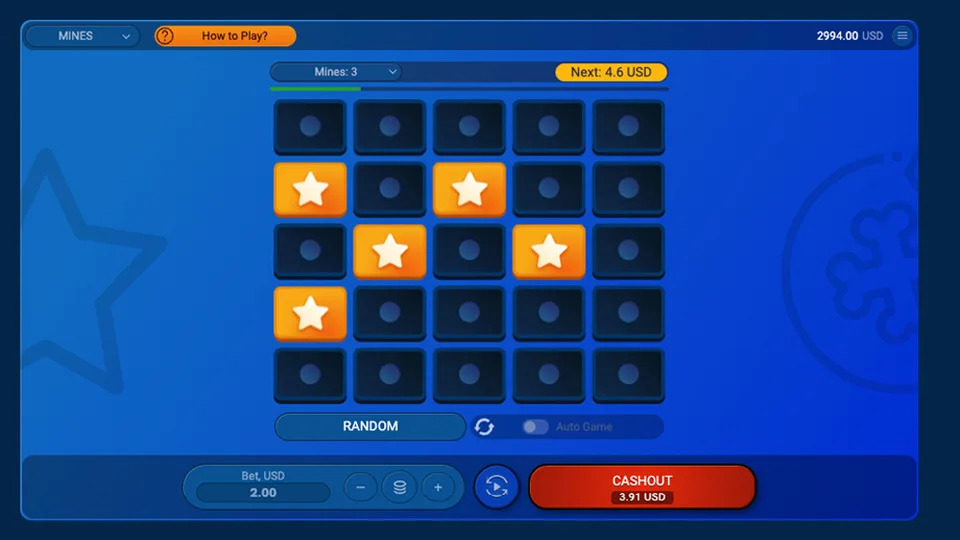
Picture a square of 25 face-down tiles. Some cover stars, the rest cover mines, and you decide how many mines go in before the round starts. Every star you flip lifts the multiplier on your stake. Flip a mine and the round is over, stake gone. As soon as a star is face up, Cash out lights up and pays the stake times the figure on screen.
Mines sits in the Spribe Turbo range, a set of short solo games that share the provably fair engine behind Aviator. There is no flying plane and no shared lobby. The board sits still until you touch it, which makes it feel calm on a small screen in a matatu or during a lunch break. That calm is the trap. Nothing outside you says stop, so the stop has to be your own rule.
Spribe quotes a 97% RTP, and the game rules give the maximum winning odds as 5,044,291x. Each casino still caps the real payout at its own level. If you want to know what a long-run figure like 97% does and does not promise, our RTP guide covers it.
Buttons and settings, from top to bottom
- Stake. Pick a preset chip or key in an amount such as KSh 50 or KSh 100.
- Mines selector. A dropdown that sets how many mines are hidden. Per the rules, this setting changes the odds and the multiplier together; the paytable inside the game covers settings from 1 to 20 mines.
- Start. The layout is locked by the provably fair seeds at this point, before any tile is opened.
- Tap a tile or use Pick randomly. The random button chooses a tile for you; it has the same chance of a star as your own finger.
- Cash out. Available after the first star. It pays stake times current multiplier and closes the round.
- Auto Game. Mark your tiles, open the auto settings, choose a number of rounds and stop limits, and the same tiles are played again each round. A counter shows what is left and can be tapped to halt it. Some casinos switch this mode off, as the rules mention.
When a round ends, the board flips open so you can see where every mine sat.
Counting your chances tile by tile
Every closed tile has the same chance of holding a mine, so the odds are just counting. With a single mine, 24 of 25 tiles are safe on the first tap, which is 96%. Five mines leave 20 safe tiles, so 80%. Ten mines drop it to 60%, and with 20 mines only 5 tiles out of 25 are stars, a 20% shot. After each star there is one safe tile fewer, so the next tap is slightly worse than the one before.
To find the chance of a run of stars, multiply the single-tap chances together. With 3 mines, two stars in a row come up about 77% of the time. The table below lines up a few plans with the approximate multiplier you would see at a 97% return.
| Mines | Stars before cash out | Approx. multiplier | Chance of getting there | KSh 100 stake pays |
|---|---|---|---|---|
| 1 | 8 | 1.43x | 68.0% | KSh 143 |
| 3 | 2 | 1.26x | 77.0% | KSh 126 |
| 5 | 3 | 1.96x | 49.6% | KSh 196 |
| 6 | 5 | 4.43x | 21.9% | KSh 443 |
| 10 | 3 | 4.90x | 19.8% | KSh 490 |
| 20 | 1 | 4.85x | 20.0% | KSh 485 |
Multiply any multiplier by its chance and you land close to 0.97. Take the 5-mine row: 1.96 times 49.6% is about 0.97. The 10-mine row works the same way, 4.90 times 19.8% is again about 0.97. Each line of the table carries the same 3% house edge, just packaged differently.
Why the paytable shows those numbers
A perfectly even game would pay one divided by your chance of survival. Spribe pays 97% of that even figure. Run it for 6 mines and two stars: survival is about 57%, the even payout would be roughly 1.75x, and trimming it to 97% gives about 1.70x. Push the same sum to the extreme and you reach the top number in the rules. With 12 or 13 mines, opening every star on the board is one layout in 5,200,300, and 97% of 5,200,300 is exactly 5,044,291.
So the figures here are the arithmetic under the hood, not a copy of the in-game table. Open the paytable inside the game for your chosen mine count and compare. If something looks off, trust the game screen, and also look at Game Limits in the menu for the maximum win your casino allows.
Three shilling plans side by side
Say you bring KSh 2,000 to a session and play KSh 100 a round. Here is how three different plans behave over time.
- Slow and steady. 3 mines, bank after two stars. Roughly three rounds in four return KSh 126, a KSh 26 profit, and the fourth usually loses KSh 100. The balance drifts rather than jumps.
- Coin flip. 5 mines, bank after three stars. About half the rounds pay KSh 196, close to doubling the stake, and the other half lose the KSh 100. Expect runs of four or five losses in a row now and then.
- Long shot. 10 mines, bank after three stars. Only about one round in five pays KSh 490. Twenty rounds of this plan can easily show fifteen losses, so a KSh 2,000 budget can disappear before a single win lands.
None of the three is better on average. They differ only in how bumpy the ride is. One more point that catches new players: a mine never just removes your profit. If the screen showed 1.96x on KSh 100 and you tapped once more and hit a mine, you do not walk away with your KSh 100. You walk away with nothing from that round.
Picking a mine count for your style
Because the average return does not change, the mine selector works as a volatility control. One to three mines suit a long, quiet session where small wins keep the balance ticking. Four to eight mines give a choppier game with wins close to double or triple the stake. Ten mines and above behave like a raffle ticket, mostly losing rounds with an occasional large hit.
Choose once per session and write it down if it helps: mine count, stars before banking, stake. The classic mistake is jumping from 3 mines to 10 after a bad patch to win it all back in one round. That is a chasing system in a different shirt, and the 3% edge applies to the bigger stakes just the same.
Patterns, predictors and other myths
Tile patterns get passed around in group chats all the time: corners first, the centre square, a diagonal, or avoiding last round's mine spots. None of them changes anything. The seeds fix the board when the round starts, every closed tile has the same chance, and the previous board tells you nothing about the next one.
Be even more careful with paid predictor apps, Telegram signal groups and bots that claim to see where the mines are. They cannot read a layout that is locked by hashed seeds before you tap. At best they sell you a random guess; at worst they take your money or ask for your login details. Never pay for one, and never hand over account access.
Checking a board with provably fair
Spribe builds every result from seeds. Before you play, the operator creates a server seed and shows you only its hashed form, so it cannot be changed after the fact. Your client seed is made on your own device and can be swapped in the Provably Fair settings. The two are combined into a SHA512 hash, and for Mines, Spribe explains, that result must contain the mine coordinates. To audit a round, go to the bet records section and press the small fairness icon beside that bet. You will see both seeds, the combined hash and the layout it produced.
Budget, data drops and the law in Kenya
A workable approach is a fixed amount per session with a flat stake that is a small slice of it, for example KSh 20 to KSh 50 rounds from a KSh 1,000 pot. Rounds go by quickly, especially with Pick randomly or Auto Game, so count rounds as well as shillings. If you top up with M-Pesa or Airtel Money, treat every top-up as part of that same session pot rather than a fresh start, and keep chama money, rent and school fees well away from it.
If your Safaricom bundle runs out or the network drops mid-round, the rules state that the round is settled at whatever multiplier you had reached, and that win is paid to your balance. A technical fault cancels the affected bets and payouts, and stakes are refunded.
Gambling in Kenya now falls under the Gambling Control Act 2025, which set up the Gambling Regulatory Authority of Kenya in place of the Betting Control and Licensing Board. Play only with operators licensed to serve Kenya, and only if you are 18 or older. Real-money play is entertainment with a cost, never a way to make income.
Practising in the free demo
The demo on this page runs Spribe's official build with play money, and our free demo guide has tips for using practice credit well. A useful drill: pick one row from the odds table, play 50 rounds following it exactly, and keep a tally of how often you reach your target. Your hit rate will end up close to the percentage in the table, and seeing that on your own phone teaches more than any article.
If you enjoy short instant rounds, Spribe's Plinko settles everything with one drop. For a shared round and a live multiplier, there is Aviator.
Where to play Mines in shillings

Questions from Kenyan players
What RTP does Spribe give Mines?
The published return for Mines is 97%. That average covers every mine setting and every cash-out point over a very long run, so changing the mine count changes how bumpy the rounds are, leaving the long-run figure where it is.
How many mines can I put on the board?
A dropdown sets the count before every round. The game's own paytable lists multipliers for any setting from 1 to 20 mines. More mines mean a lower chance of each safe tile and a bigger jump in the multiplier per star.
What are my chances of a safe first tile?
It depends on your setting. On 25 tiles, 1 mine gives a 96% safe first tap, 5 mines give 80%, 10 mines give 60% and 20 mines give only 20%.
Do I keep my stake if I hit a mine?
No. A mine ends the round and takes the whole stake along with the multiplier you had built. Play KSh 100 and hit a mine, and the full KSh 100 is lost.
How big can a Mines payout get?
Spribe's rules give maximum winning odds of 5,044,291x. Every casino sets its own ceiling on the actual payout, listed in the Game Limits part of the menu.
Do Mines predictor apps work?
No. The layout is fixed by hashed seeds before the first tap, and every closed tile has the same chance of hiding a mine. Paid predictors and signal groups cannot see the board, so never pay for them or share your login.
Can I play Mines for real money in Kenya?
Only with an operator licensed to serve Kenya under the Gambling Control Act 2025, which created the Gambling Regulatory Authority of Kenya. You must be 18 or older. The demo on this page is free.