On this page
- What Mines is
- How a round works, step by step
- How the mine count shapes the odds
- Where the multipliers come from
- Worked examples
- Choosing a mine count that fits your session
- Provably fair: how mine positions are set
- Bankroll and why progressions fail
- Auto game and other rules
- Trying Mines in the free demo
- Mines free demo
- Frequently asked questions
What Mines is
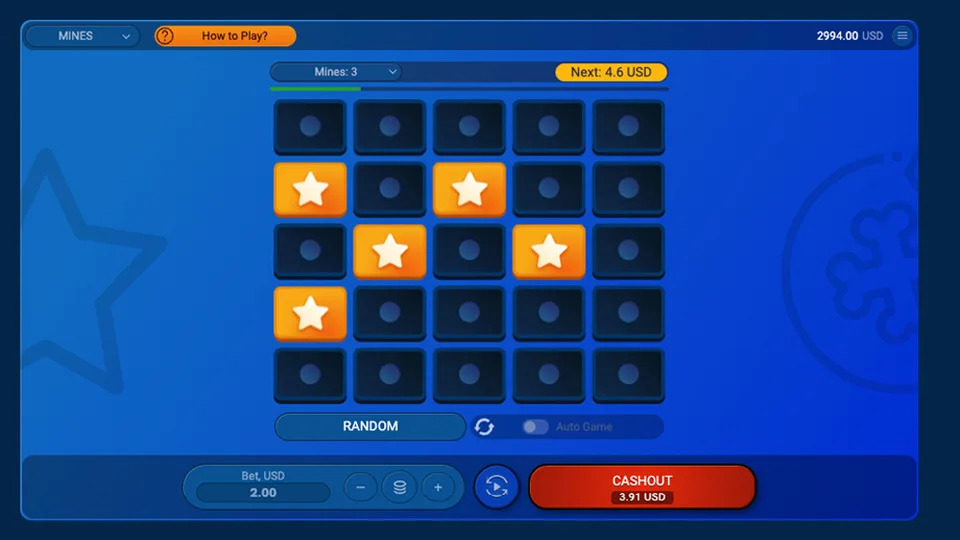
Mines belongs to Spribe's Turbo line, fast single-player games built on the same provably fair engine as the studio's crash title. The idea will feel familiar to anyone who played the classic computer puzzle: a grid of closed tiles hides stars and mines. Each star you open raises your payout multiplier. Each mine ends the round and takes the stake with it.
Unlike a crash game, nothing moves on its own. There is no timer and no plane about to fly away. You decide when to open the next tile and when to stop, and you can cash out after any successful pick. That makes Mines a pure test of discipline: the math is visible, and the only real decision is how far to push.
Spribe lists the game's return to player at 97%, and its rules put the maximum winning odds at 5,044,291x, with the actual maximum win capped by each casino. Our RTP guide explains what the 97% figure means over the long run.
How a round works, step by step
- Set the stake. Choose a preset amount or type your own.
- Choose the number of mines. Pick it from the dropdown. According to the rules, this affects the game odds and the bet multiplier. The in-game paytable lets you view multipliers for 1 to 20 mines.
- Start the round. Mine positions are fixed by the provably fair system at this point.
- Open tiles. Click any tile, or press Pick randomly to let the game choose. A star raises the multiplier; a mine ends the round.
- Cash out or continue. After each star you can press Cash out to take your stake times the current multiplier, or keep going.
- Reveal. When the round ends, the field is shown and the result can be checked for fairness.
How the mine count shapes the odds
The maths behind Mines is transparent because every closed tile is equally likely to hide a mine. On a field of 25 tiles with 3 mines, the chance that your first pick is a star is 22 in 25, or 88%. Surviving two picks is about 77%, three picks about 67%, four about 58%, and five about 50%. Each extra pick is a new, slightly worse coin toss, because fewer safe tiles remain.
More mines shift those numbers fast. With 12 mines, the first pick is safe only 13 times in 25, about 52%. With 24 mines, only one tile out of 25 is a star. That is why the mine dropdown is really a volatility dial: few mines mean frequent small steps, many mines mean rare, steep jumps.
Where the multipliers come from
A fair game would pay the inverse of your survival chance. Mines pays that fair figure scaled by the 97% RTP. With 3 mines, the fair odds for one star are 25 / 22, about 1.136, and 97% of that is about 1.10x. For three stars the fair odds are about 1.49, which becomes about 1.45x.
This model matches Spribe's own top figure exactly. The best possible round is 12 or 13 mines with every star opened: there are 5,200,300 possible layouts, and 97% of that is 5,044,291, the maximum winning odds quoted in the rules. Treat the figures here as the math behind the paytable, and read the exact values in the game's paytable before you play.
Worked examples
| Mines | Stars opened | Approx. multiplier | Stake 2.00 returns |
|---|---|---|---|
| 1 | 5 | 1.21x | 2.42 |
| 3 | 3 | 1.45x | 2.90 |
| 3 | 5 | 1.96x | 3.92 |
| 5 | 4 | 2.53x | 5.06 |
| 10 | 5 | 17.16x | 34.32 |
Take the 3-mine row with five stars. At a 2.00 stake you would cash out about 3.92, a profit of 1.92, but only about half of all rounds get that far. With 10 mines, five stars pay about 17x, yet the chance of five safe picks in a row falls to roughly 5.7%. Higher numbers are always paid for with lower odds.
One practical trap: in Mines a loss costs the full stake, not the profit you had built up. If you had 1.96x on screen and open a mine, you do not lose 0.96x of profit, you lose the whole bet.
Choosing a mine count that fits your session
Because the average return is the same across settings, the right mine count is about how you want the session to feel. Three broad profiles cover most play:
- 1 to 3 mines. Most picks are safe and each star adds only a little. Good for long, low-stress sessions and for learning the interface. The cost is that you need many stars for a meaningful win.
- 4 to 8 mines. A middle ground where three stars pay roughly 1.7x to 3.3x, while the first pick is still more likely safe than not.
- 10 mines and up. Every pick is close to a coin flip or worse, and a handful of stars can pay tens of times the stake. Expect long losing runs and size the stake for them.
Whatever you pick, keep the plan fixed for the session. Switching to more mines to recover a loss is a progression in disguise.
Provably fair: how mine positions are set
Spribe's provably fair system generates each result from seeds rather than a hidden server roll. The operator creates a server seed and publishes its hashed version before the round, so it cannot be swapped later. Your client seed is generated on your side and can be changed in the Provably Fair settings. The seeds are combined into a SHA512 hash, and each game turns that hash into a result with its own math. For Mines, Spribe notes, the result has to contain the coordinates of the mines.
To check a round, open your bet records from the game menu and press the provably fair icon. You will see the server seed, your seed, the combined hash and the mine layout it produced.
Bankroll and why progressions fail
The same 3% edge applies whatever mine count or cash-out point you choose. You pick the shape of the risk, not the average return. Over many rounds, about 97 units come back for every 100 wagered.
Doubling after losses does not change that. At a target with roughly even chances, five losses in a row starting at 1.00 cost 31.00, and the next stake must be 32.00 to end one unit ahead. The expected loss is 3% of the total wagered, so a progression raises it by raising the total. Casino bet limits and your balance also stop the chain long before it can recover.
A better approach is to decide your mine count and your cash-out step before the round starts, and stick to it. For example, 3 mines and a cash-out after three stars gives you about a two-in-three chance to win around 1.45x each round.
Auto game and other rules
Mines has an Auto Game mode. You first select the tiles you want on the board, then open the Auto Play settings and choose the number of rounds and your stop conditions. The same tiles are then played each round, and the remaining count shows on a counter you can click to stop at any time. Some casinos disable autoplay, as the rules note.
If your connection drops while a bet is active, the rules say the game cashes out at the current multiplier and credits the win. A malfunction voids all affected bets and pays, which are refunded.
Trying Mines in the free demo
The demo above loads Spribe's official build with demo money. Our free demo guide explains how to use practice play well. In Mines, open the paytable for your favourite mine counts and compare its values with the odds above, then play 30 rounds with a fixed cash-out rule and see how often you get there.
In your casino's version, check the RTP line and the Game Limits section, which shows the maximum win. If you like instant games, try Spribe's Plinko, or move to the shared-round format of Aviator.
Where to play Mines for real money

Frequently asked questions
What is the RTP of Spribe Mines?
Spribe lists Mines at 97% RTP. That is a long-run average across all mine counts and cash-out points. The mine count changes how risky each round is, not the average return.
How many mines can you choose in Mines?
The number of mines is set from a dropdown before the round, and the in-game paytable shows multipliers for 1 to 20 mines. More mines lower the chance of each safe pick and raise the multiplier for every star.
What is the maximum win in Mines?
Spribe's rules put the maximum winning odds at 5,044,291x. The actual maximum win is limited by each casino and shown in the Game Limits section of the menu.
Can you cash out at any time in Mines?
Yes, after any successful pick. Press Cash out to take your stake times the current multiplier. If you open a mine before cashing out, the whole stake is lost.
Is Mines by Spribe provably fair?
Yes. The mine layout is derived from a SHA512 hash of the operator's server seed, published in hashed form before the round, and your client seed. You can verify each round from your bet records.
What are the odds of the first pick being safe?
It depends on the mine count. With 3 mines on 25 tiles, 22 tiles are stars, so the first pick is safe 88% of the time. With 12 mines, it drops to about 52%.
Is there a strategy that beats Mines?
No. Every choice of mine count and cash-out point carries the same house edge. Tile patterns do not matter, since every closed tile is equally likely to hide a mine, and doubling after losses only raises the total wagered.