On this page
- JetX in a nutshell
- One flight from start to finish
- Cashout examples in rupees
- Four bets on one flight
- Reading the stats without fooling yourself
- Autoplay and auto cashout
- How the RTP range works
- Bankroll and why progressions fail
- Connection drops and other rules
- Playing from India
- Practising in the free demo
- JetX free demo
- Frequently asked questions
JetX in a nutshell
JetX is the best-known title from SmartSoft Gaming, a studio licensed in Malta. It launched in 2018, and SmartSoft presents it as the first flying crash game, the design that shaped the whole category. The principle is simple: a jet takes off, a multiplier rises in real time, and you choose when to collect. If the jet explodes before you do, the stake is lost.
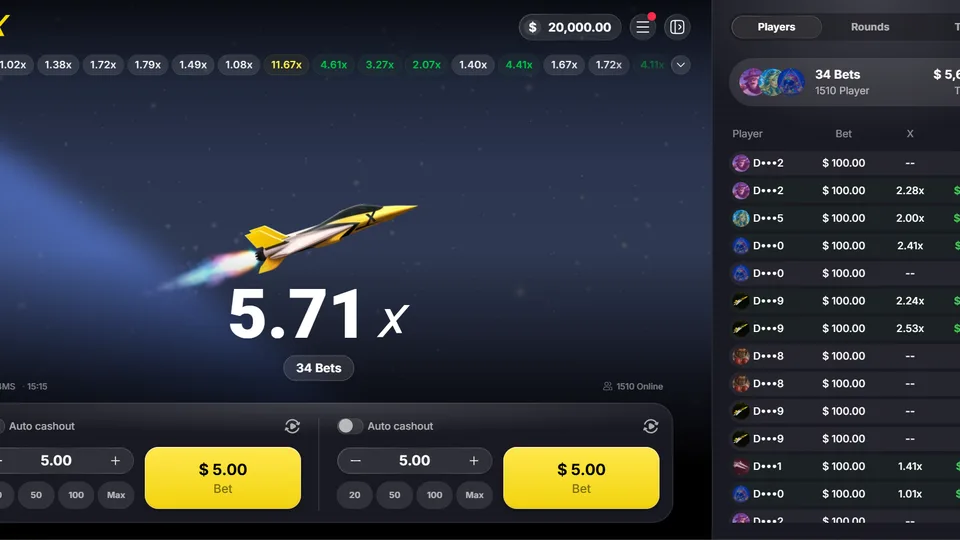
In September 2026 SmartSoft released what it calls the New Era of JetX. The studio says the rebuilt client is 50% lighter at 3.9 MB and loads 60% faster, which is good news on an entry-level phone or a crowded 4G network. The same update raised the number of simultaneous bets to four and added live player data, a larger centred multiplier, advanced autoplay and casino promotions such as MegaDrop and jackpots.
SmartSoft classes JetX as high volatility, and its rules quote a return to player between 96.2% and 98.9%, depending on your settings and your casino's configuration. We unpack that range further down.
One flight from start to finish
- Bets are accepted. Before take-off you place one, two or four separate bets. Each has its own amount, adjusted with plus and minus, inside the minimum and maximum shown in the game.
- The jet takes off. The round begins and the multiplier starts climbing from 1.00x.
- Cashout unlocks. The Cashout button becomes active at 1.01x, the minimum multiplier in the rules.
- Collect or hold. Tap Cashout on any bet, or let auto cashout close it at your preset value. You win your stake times the multiplier at that moment.
- The jet explodes. At an end point set by the game system the round finishes. Any bet still flying is lost.
- The strip updates. The result is added to the multiplier strip: white for 1.00x to 2.00x, green for 2.00x to 10.00x, yellow for 10.00x and above.
The rules state plainly that speed, skill, experience or strategy have no influence on the result or on where the round ends. Your one real decision is when to get off.
Cashout examples in rupees
A successful cashout pays the stake multiplied by the multiplier at that moment.
| Stake | Cashout at | You get back | Profit |
|---|---|---|---|
| ₹200 | 1.85x | ₹370 | ₹170 |
| ₹100 | 1.30x | ₹130 | ₹30 |
| ₹400 | 2.50x | ₹1,000 | ₹600 |
| ₹20 | 50.00x | ₹1,000 | ₹980 |
₹200 cashed at 1.85x returns ₹370. The other side of the coin is just as simple: if the jet explodes at 1.70x while you are holding out for 1.85x, the whole ₹200 is gone. There is no partial payout for a near miss.
Four bets on one flight
Multiple bet slots let you split a single round into several levels of risk. The current rules allow one, two or four bets on the same flight, and each can run its own autoplay and auto cashout.
Try a four-bet ladder of ₹50 each, ₹200 in total, with auto cashout at 1.50x, 2.00x, 4.00x and 10.00x. If the jet reaches 5.20x, the first three pay ₹75, ₹100 and ₹200 and the fourth loses: ₹375 back on ₹200. If it explodes at 1.80x, only the first pays: ₹75 back, a loss of ₹125. If it explodes at 1.20x, all four lose. A ladder evens out each round's result; it does not change the expected return on any of the four bets.
Reading the stats without fooling yourself
JetX shows plenty of data: the recent multiplier strip, round records, top wins by day, week and month, and in the new build live player activity. It is tempting to see patterns, for example a run of white results that feels "due" to end with a big yellow one.
The rules shut that door. They say each result is independent of previous rounds, the bet amount, cashout choices and betting strategy. Ten low rounds in a row do not make the eleventh any more likely to fly high. Enjoy the panel as a picture of how often each range shows up over a long sample, not as a tip for the next flight. The numbers that should drive your decisions are your stake, your target and your budget.
Autoplay and auto cashout
Autoplay repeats the same bet amount every round, on one or all active bet slots. Auto cashout closes a bet as soon as the multiplier reaches your chosen value, anywhere from 1.01x up to a maximum your casino sets. You can still cash out by hand before the auto value while the round is live.
Auto cashout matters more than it seems because JetX runs in real time. The rules note that a cashout request usually takes 200 to 300 milliseconds to reach the server and is settled at the multiplier the server sees when it processes it, provided the round is still running. On a weak mobile signal a last-second manual tap can arrive too late. An auto target avoids that delay.
How the RTP range works
Most slots have a single RTP per build. JetX quotes 96.2% to 98.9% for two reasons given in its rules: the configuration your casino picks and the gameplay settings you choose. The rules add that the highest RTP may be reached by choosing the lowest available cashout multiplier.
In rupees: ₹10,000 wagered at the bottom of the range returns about ₹9,620 on average, and at the top about ₹9,890. The ₹270 gap per ₹10,000 is real, but it only appears across a great many rounds. Any single evening is ruled by variance, especially with high targets.
So open the rules screen in your casino's version and read the exact percentage, the maximum multiplier and the maximum win per bet. When the jet hits the maximum multiplier, or a bet reaches the win cap, the game cashes out automatically. Jackpot rules, where a casino runs them, are listed there too.
Bankroll and why progressions fail
Because low targets land often, doubling after each loss looks like a way to always finish ahead. At a 2.00x target starting from ₹100, five losses in a row cost ₹100 + ₹200 + ₹400 + ₹800 + ₹1,600 = ₹3,100, and the sixth bet must be ₹3,200 to end just ₹100 up. Such runs are rare in one session but certain over time, and the table maximum or your balance ends the chain first.
Under the surface every bet carries the same house edge, so the expected loss equals that edge times the total wagered. A progression raises the total wagered and the expected loss with it. It never turns a negative expectation into a positive one.
A calmer plan is a flat stake sized to a fixed session budget. With high volatility in mind, a ₹2,000 budget sits better with stakes of ₹20 to ₹50 than with ₹500 bets, and you should decide in advance when you will stop.
Connection drops and other rules
JetX treats a loss of connection lasting more than 6 seconds as a disconnection, and what happens next depends on timing:
- During bet acceptance: your bet stays valid for the round. Reconnect in time and you can still cash out.
- After take-off: the system tries to cash out your active bet at the multiplier when the drop was detected.
- With auto cashout set: the bet stays live until your auto value is reached or the round ends.
- With autoplay on: autoplay switches off after the next round.
As with every casino game, a malfunction voids all pays and plays.
Playing from India
JetX appears in the crash sections of many international casinos that accept rupees, and our 1WIN review shows how one of them handles INR. The legal position of real-money online games in India comes from central law, including the Promotion and Regulation of Online Gaming Act of 2025, and from state rules that are not the same everywhere, so check what applies in your state. Play only if you are 18 or older.
Practising in the free demo
The demo on this page loads SmartSoft's official build with demo credits, so you can try the four bet slots and auto cashout for free. Our demo guide explains how to get real value from practice play. Useful checks: how quickly the multiplier passes your usual target, how a ladder of auto cashouts pays over a dozen flights, and how the strip reflects long runs of white results.
If the format suits you, compare it with Aviator, which runs two bets and a seed check per round, and Spaceman, where half a stake can be banked mid-flight.
Where JetX is offered for real money

Frequently asked questions
What is the RTP of JetX?
SmartSoft's rules for the current JetX give an RTP of 96.2% to 98.9%, depending on gameplay settings and the casino's configuration. The highest RTP may come from choosing the lowest available cashout multiplier. Check the exact figure in your casino's rules screen.
How many bets can I place in JetX?
The current build lets you place one, two or four separate bets on the same flight, each with its own stake, cashout, autoplay and auto cashout. Older versions allowed one or two bets.
Can I play JetX in rupees?
Many casinos run JetX with INR as the account currency, so stakes and wins are shown in rupees. The minimum and maximum bet, the maximum multiplier and the maximum win are set by each casino and listed in the rules. Real-money play is for adults aged 18 and over.
What is the minimum multiplier in JetX?
The minimum multiplier is 1.01x, and the Cashout button becomes available once the multiplier reaches it. Auto cashout can be set from 1.01x up to a maximum defined by the casino.
Is JetX high volatility?
Yes. SmartSoft lists JetX as a high volatility crash game. In practice your cashout target shapes the ride: low targets pay small and often, while high targets bring long losing runs between larger wins.
Does a betting system beat JetX?
No. The rules say skill, speed or strategy do not influence results. Every bet carries the same house edge, so doubling after losses only raises the total wagered and the expected loss. From ₹100, five straight losses already cost ₹3,100.
When was JetX released?
SmartSoft Gaming launched JetX in 2018 and describes it as the first flying crash game. The rebuilt New Era of JetX followed in September 2026 with a lighter client, faster loading and up to four bets per round.