On this page
- The jet that started the crash genre
- What happens on every flight
- Single-stake payouts in rand
- A four-rung ladder on one jet
- Why 96.2% and 98.9% are both correct
- White, green and yellow results
- Milliseconds, auto exits and lost signal
- Doubling, budgets and high volatility
- Rules screen, legal position and 18+
- Getting the most from the demo
- JetX demo for free
- Questions from South African readers
The jet that started the crash genre
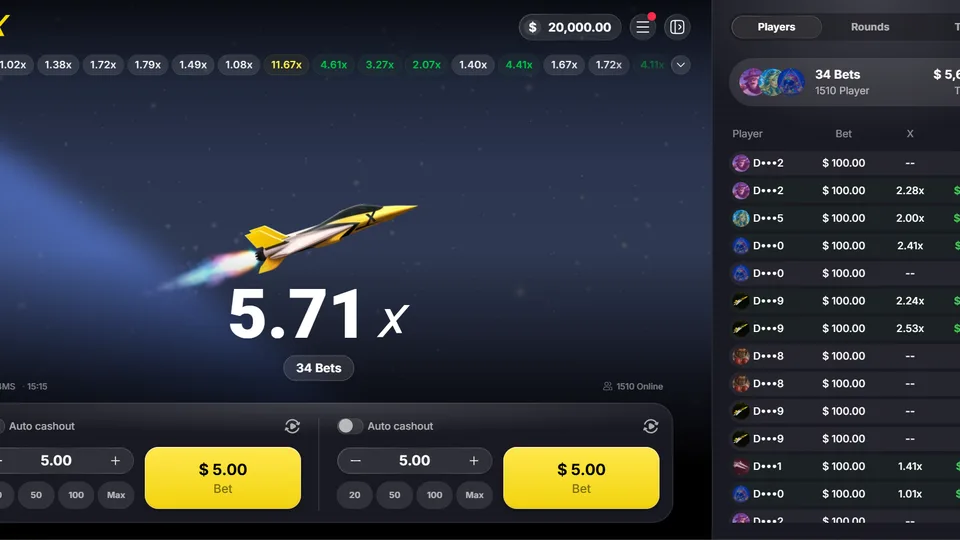
SmartSoft Gaming, a studio holding a Malta licence, put JetX out in 2018, and in the studio's own words no flying crash game came before it. Plenty of later titles copied the idea: something takes off, a number grows in real time, and you choose when to collect. If the jet explodes before you collect, your rands go with it.
In September 2026 the studio relaunched the game as the New Era of JetX. SmartSoft says the new client is half the size at 3.9 MB and opens 60% faster, a handy change on a capped data bundle or when the tower is struggling during load-shedding. The update also lifted the stake limit to four per flight, added live player figures, an enlarged multiplier placed mid-screen and deeper autoplay settings. Operators gained promo tools such as MegaDrop and jackpots.
SmartSoft's own catalogue labels JetX high volatility. The rules put return to player somewhere from 96.2% to 98.9%, depending on your settings and on the configuration your operator runs. Further down we unpack what that band means in rand.
What happens on every flight
- Stakes go in. Before departure you load one, two or four stakes. Each takes its own amount, set with plus and minus between the on-screen minimum and maximum.
- Departure. The jet lifts and the multiplier starts moving up from 1.00x.
- Cashout unlocks. At 1.01x, the lowest multiplier the rules allow, the Cashout key goes live.
- Bank it or hold. Tap Cashout on any stake or let your automatic value do it. You receive stake times the multiplier at that point.
- Boom. At an end point chosen by the game system, the jet explodes and every stake still flying is lost.
- Strip refreshes. The finish is logged on the results strip in one of three colours.
SmartSoft is blunt in the rules: speed, skill, experience and strategy have zero effect on where a flight ends. The single choice that belongs to you is when to step off.
Single-stake payouts in rand
A successful cashout pays your stake multiplied by the figure on screen when it registers.
| Stake | Banked at | Returned | Net |
|---|---|---|---|
| R10 | 1.30x | R13 | +R3 |
| R20 | 1.85x | R37 | +R17 |
| R40 | 2.50x | R100 | +R60 |
| R2 | 50.00x | R100 | +R98 |
| R20 | exploded first | R0 | −R20 |
Take the R20 row. Bank at 1.85x and R37 lands in your balance. Hold out for 1.85x on a flight that ends at 1.70x and the entire R20 disappears. JetX pays nothing for coming close, so a missed target is a full loss.
A four-rung ladder on one jet
With several stake slots you can carve a single flight into different risk levels. The current rules permit one, two or four stakes per jet, and every slot carries its own autoplay and automatic exit.
Picture R5 on each of four slots, R20 committed, with automatic exits at 1.50x, 2.00x, 4.00x and 10.00x. A jet that climbs to 6.30x pays R7.50, R10 and R20 on the first three while the fourth burns: R37.50 back, a R17.50 gain. A jet that explodes at 1.90x pays only the lowest rung, R7.50, so you are down R12.50. At 1.15x all four go. The ladder evens out how individual flights feel; the long-run expectation of each rung stays exactly where it was.
Why 96.2% and 98.9% are both correct
A typical slot runs one RTP per version. JetX gives a band, and the rules name two drivers: the configuration chosen by the operator and the gameplay settings chosen by you. They also note that the top of the band may be reached by picking the lowest cashout multiplier on offer.
In rand terms, R1,000 pushed through the game at the bottom of the band returns roughly R962 over the long haul, and at the top roughly R989. That R27 gap per R1,000 is genuine, but it only surfaces after a great many flights. Inside one evening, variance swamps it, and with high targets it swamps it completely.
So the practical move is to open the rules in your operator's build and write down three things: the precise RTP, the multiplier ceiling and the most a single stake can win. Reach either ceiling and the game banks the stake for you. If jackpots are switched on, their conditions appear in that same screen.
White, green and yellow results
Every finished flight is painted onto the strip: white covers 1.00x to 2.00x, green covers 2.00x to 10.00x, and yellow marks 10.00x or more. Alongside it sit round records, leading wins for the day, the week and the month, and, in the rebuilt client, live player activity.
It is easy to stare at eight whites in a row and decide a yellow is overdue. The rules shut that idea down: no flight is affected by earlier flights, by stake size, by anyone's cashouts or by a betting approach. Use the strip to get a feel for how often each colour shows up across a long run, and leave it there. Your stake, your target and your budget are the only figures that deserve a say in your next click.
Milliseconds, auto exits and lost signal
Autoplay re-enters the same amount each flight, on one slot or on all of them. The automatic exit closes a stake once the multiplier touches your value, which can be anything from 1.01x to the operator's ceiling. Manual cashout still works earlier, provided the jet is airborne.
Why does this matter? The rules say a cashout request typically takes between 200 and 300 ms to get to the server, and it settles at the multiplier the server sees on arrival, as long as the flight is still going. On a weak connection a last-gasp tap can arrive after the explosion. A preset exit avoids that delay.
A connection gap longer than 6 seconds counts as a disconnection, and what follows depends on timing:
- Lost while stakes are open: your stake still flies, and you can cash it if you get back in time.
- Lost mid-flight: the system attempts to bank your stake at the multiplier showing when the gap was noticed.
- Automatic exit already set: the stake waits for your value or the end of the flight.
- Autoplay running: it switches itself off after the following flight.
Any malfunction voids all pays and plays, as with every casino game.
Doubling, budgets and high volatility
Low exits land so often that chasing losses with bigger stakes feels safe. Try it at 2.00x from R10: five misses cost R10 + R20 + R40 + R80 + R160 = R310, and stake six must be R320 to clear a measly R10. Such runs are uncommon in any single hour yet guaranteed over enough flights, and the maximum stake or your balance cuts the chain short.
Underneath it all, every stake has an identical house margin, and your expected loss is that margin multiplied by turnover. Doubling raises turnover and therefore raises the expected loss. It cannot turn a losing expectation into a winning one.
A steadier plan is a flat stake sized to a session budget you set before the first flight. For a high-volatility game, keep each stake small enough to ride out a long spell without a cashout, and pick your stopping point up front, whether that is a rand figure or the end of the PSL match you have on in the background.
Rules screen, legal position and 18+
Every operator configures its own bet limits, multiplier cap and win cap, so the rules page of the version in front of you is the only reliable source for those numbers. On the legal side, the National Gambling Act 2004 does not authorise online casino games in South Africa, and the lawful online option is sports betting with a provincially licensed bookmaker. We do not encourage breaking local law and never recommend VPNs or ways around blocks. Gambling is for adults aged 18 and over.
Getting the most from the demo
The demo above runs SmartSoft's official build on play credits, so testing the four slots and the automatic exits costs nothing. Our free demo guide covers how to make practice sessions useful. In JetX, time how quickly the multiplier passes your usual target, run a four-rung ladder for a dozen flights and total what it returns, and notice how long white streaks can stretch.
Enjoy the format? Set it beside Aviator, where two stakes share each round and you can verify the seeds, and Spaceman, which lets you bank half a stake mid-flight.
Where JetX is offered

Questions from South African readers
What RTP does JetX pay?
The current JetX rules give a range of 96.2% to 98.9%, set by the operator's configuration and your own gameplay choices. Selecting the lowest available cashout multiplier may achieve the top of that range. The exact figure for your version sits in the rules screen.
How many stakes can I run on one JetX flight?
The rebuilt JetX accepts one, two or four stakes per flight. Every slot has its own amount, cashout button, autoplay and automatic exit. Earlier versions capped it at one or two.
What is the lowest cashout in JetX?
1.01x. The Cashout button only activates once the multiplier reaches or passes that value, and automatic exits can be set anywhere from 1.01x up to a ceiling chosen by the operator.
How volatile is JetX?
SmartSoft Gaming classifies JetX as high volatility. Your exit target shapes how that feels: a 1.30x target on R10 returns small amounts often, while a 20x target brings long dry runs between bigger hits.
Is JetX legal in South Africa?
The National Gambling Act 2004 does not authorise online casino games in South Africa; the legal online route is sports betting through provincially licensed bookmakers. We never advise VPNs or getting around blocks. Our demo uses play credits only, and gambling is for over-18s.
What is the top win in JetX?
Each operator fixes its own multiplier ceiling and its own per-stake win cap, both printed in the rules. Should a flight touch that multiplier, or a stake run into the cap, JetX banks it without waiting for you.
What year did JetX launch?
JetX dates from 2018, and SmartSoft Gaming presents it as the original flying crash game. A relaunch branded New Era of JetX arrived in September 2026, bringing a 3.9 MB client, quicker start-up and four stake slots.