On this page
- Aviator in a nutshell
- One round from start to finish
- Cash-out examples in rupees
- Running two bets at once
- Auto Play and Auto Cash Out
- How the crash point is generated
- What 97% RTP means in a crash game
- Why doubling after a loss does not work
- Live bets, chat and limits
- Playing from India
- Practising in the free demo
- Aviator free demo
- Frequently asked questions
Aviator in a nutshell
Aviator comes from Spribe, the studio that did more than anyone to move crash games from crypto sites into mainstream online casino lobbies. Spribe says the game first went live in February 2019. A later rebuild, Aviator 2.0, brought quicker loading and a lighter client, which matters on budget Android phones and patchy mobile data.
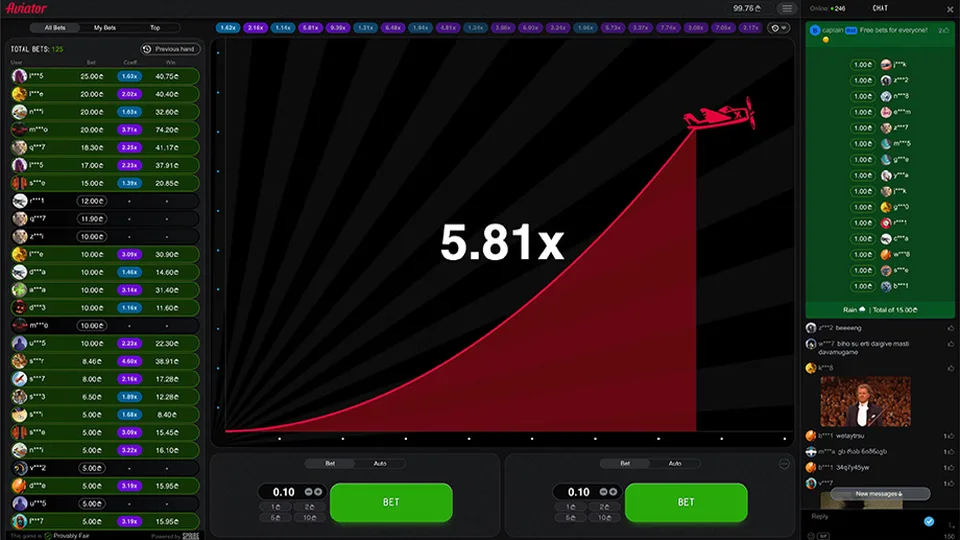
Forget reels, symbols and paylines. A round is one rising curve. The plane takes off, the multiplier starts at 1.00x and keeps climbing, and at a random moment the plane flies off the screen. Press Cash Out before that moment and your stake is multiplied by the number on screen. Miss it and the stake is gone.
Spribe lists the return to player at 97%, and the crash point of every round is produced by a provably fair process that you can check yourself. New to the idea of return to player? Our RTP guide explains how the figure is calculated and why it only speaks about the long run.
One round from start to finish
- Place your bet. Between rounds you enter a stake in one or both bet panels, say ₹100, by typing it, tapping a preset or using plus and minus. You can cancel until take-off.
- Seeds are fixed. The casino's server seed for the round already exists, and its SHA256 hash was shown in advance. The client seeds of the first three players who bet are added to it.
- The plane takes off. The multiplier starts at 1.00x. Spribe's rules give the curve as multiplier = floor(100 x e^(0.000083 x ms)) / 100, where ms is the time in milliseconds since take-off.
- Cash out. Tap Cash Out on a panel at any moment, or let Auto Cash Out do it at your chosen value. You receive your stake times the multiplier at that instant.
- The plane flies away. At the pre-generated point the round ends. Any bet still running loses, and the final value joins the strip of recent results at the top.
That formula also tells you how long you will be waiting. Worked through, the plane passes 1.50x after about 4.9 seconds, 2.00x after roughly 8.4 seconds, 10x after about 27.7 seconds and 100x after close to 55 seconds. A low target is settled in a few heartbeats; a big target means nearly a minute of staring at the screen.
Cash-out examples in rupees
| Stake | Cashed out at | You get back | Profit |
|---|---|---|---|
| ₹200 | 1.85x | ₹370 | ₹170 |
| ₹100 | 1.20x | ₹120 | ₹20 |
| ₹500 | 3.00x | ₹1,500 | ₹1,000 |
| ₹50 | 25.00x | ₹1,250 | ₹1,200 |
The top row is the classic cautious play: ₹200 cashed at 1.85x brings back ₹370. Now the fine print from the rules. If the plane leaves at 1.25x, the last value it actually showed was 1.24x, so an Auto Cash Out set at exactly 1.25x loses. The same logic holds everywhere: your target must be passed, not merely equalled.
Running two bets at once
The feature most Indian players know Aviator for is the second bet panel, opened with the plus icon at the corner of the first. The two bets share nothing: separate stakes, separate Cash Out buttons, separate auto settings. The usual pattern pairs a safe target with a hopeful one.
Put ₹100 on each panel, with Auto Cash Out at 1.50x on the first and a manual aim of 3.00x on the second. If the round reaches 4.20x and you cash the second at 3.00x, you collect ₹150 plus ₹300, so ₹450 on ₹200 staked. If the plane leaves at 2.40x before you tap the second button, you get ₹150 back on ₹200, a loss of ₹50. If it leaves at 1.10x, both bets lose. Two panels spread the outcomes around; they do not improve the expected return of either bet.
Auto Play and Auto Cash Out
Each bet panel has an Auto tab. Auto Cash Out closes the bet the moment the multiplier passes the value you entered, which removes your reaction time and your nerves from the equation. Auto Play repeats the same bet for a chosen number of rounds, and Spribe makes you set at least one stop condition:
- Stop if cash decreases by a set amount, for example ₹1,000, which works as a loss limit.
- Stop if cash increases by a set amount, which locks in a profit.
- Stop if a single win exceeds a set amount.
If Auto Bet is on but Auto Cash Out is off, the game places bets for you but you still have to tap Cash Out yourself. For hands-free play both must be switched on. And if your connection drops mid-round, which happens on a train or in a lift, the rules say the game cashes you out at the current multiplier and credits the win.
How the crash point is generated
According to Spribe, the result of each round is fixed before take-off and comes from four participants, not from the server alone. The casino creates a 16-character server seed and shows its SHA256 hash in advance, so it cannot be swapped later. Every player also has a client seed, which you can change in the Provably Fair settings. At take-off the server seed is merged with the client seeds of the first three bettors, the combined string is hashed with SHA512, and the crash point is derived from that hash.
To verify a round, open My Bets or the Top tab and tap the fairness icon beside it. You will see the server seed, the three player seeds, the combined hash and the resulting multiplier. Want your own seed in the mix? Be among the first three to bet in that round. Aviator can also run several rooms, and each room produces its results independently with its own seeds.
What 97% RTP means in a crash game
A slot's RTP comes from reel strips and a paytable. Aviator's comes from how crash points are distributed. The rules spell it out: with a theoretical return of 97%, on average 3 rounds out of every 100 end with the plane flying away at the very start. That instant loss is where the house edge lives.
The important consequence is that 97% applies to every cash-out target equally. Cashing out at 1.20x wins often and pays little; waiting for 10x wins rarely and pays a lot. Over thousands of rounds both give back about ₹97 for every ₹100 wagered. What you are choosing is volatility, meaning how bumpy the ride feels, not a better return.
Why doubling after a loss does not work
Low targets hit so often that doubling up after a loss looks foolproof. Try it at a 2.00x target starting from ₹100: after losses you bet ₹200, then ₹400, ₹800 and ₹1,600. Five losses in a row cost ₹3,100, and the sixth bet has to be ₹3,200 just to finish ₹100 ahead. Runs like that are uncommon in an evening but guaranteed over enough rounds, and the table maximum or your balance stops the chain first.
The deeper problem is arithmetic. Each bet carries the same 3% edge, so the expected loss is 3% of everything you wager. A progression pushes up the total wagered and the expected loss with it. It swaps many small wins for a rare, heavy drawdown, and the average does not move.
The sensible alternative is a flat stake inside a fixed session budget. If ₹2,000 is what you are willing to spend tonight, a stake of ₹20 to ₹50 gives you room for dozens of rounds, and the Auto Play loss limit can hold you to that figure.
Live bets, chat and limits
Aviator is built as a shared room. The Live Bets panel shows everyone's stakes in the current round and the value each player cashed out at. The Top tab ranks the biggest wins and multipliers by day, month and year. Chat runs alongside, and big wins are posted there automatically.
The game menu also contains the Limits screen with the minimum bet, the maximum bet and the maximum win for your casino. These are operator settings, so they differ from site to site and are shown in your account currency. When a win reaches the maximum, the game cashes out on its own.
Playing from India
Many international casinos run Aviator in rupees, and you can compare how one of them handles INR in our 1WIN review. Before depositing, be aware that the legal position of real-money online games in India is set by central law, including the Promotion and Regulation of Online Gaming Act of 2025, and by state rules that differ from one state to another. Check what applies where you live. Aviator is for adults aged 18 and over only.
Practising in the free demo
The demo on this page runs Spribe's official build with play money, so you can test cash-out timing and the two-panel setup without spending a rupee. Our demo guide explains what practice play can and cannot show you. In Aviator, watch three things: how fast the multiplier passes your usual target, how Auto Cash Out behaves right at the crash point, and how a long losing run feels at your planned stake.
If you enjoy the format, compare it with JetX, which allows up to four bets on one flight, and Spaceman with its half cash-out. For a game with no timer at all, Spribe's Mines lets you decide at your own pace.
Where Aviator is offered for real money

Frequently asked questions
What is the RTP of Aviator?
Spribe lists Aviator at 97% RTP. The rules explain that on average 3 of every 100 rounds end with the plane leaving at the very start. It is a long-run average across all cash-out targets, not a promise about any single session.
Can I play Aviator in rupees?
Many casinos offer the game with INR as the account currency, and the Limits screen then shows the minimum bet, maximum bet and maximum win in rupees. These limits are set by each casino, so check them in your own version. Real-money play is for adults aged 18 and over.
Is Aviator provably fair?
Yes. The casino's server seed is hashed and shown before the round, then combined with the client seeds of the first three bettors into a SHA512 hash that sets the crash point. You can open any round from My Bets and check the seeds and the hash yourself.
How do two bets work in Aviator?
Tap the plus icon on the first bet panel to open a second. Each panel has its own stake, Cash Out button and auto settings, so you can take ₹100 out early at a low target and let another ₹100 run for a bigger one.
What happens if the plane leaves exactly at my Auto Cash Out value?
The bet counts as lost. The multiplier must pass your target, not just reach it. If the plane flies away at 1.25x, the last value shown was 1.24x, so an Auto Cash Out set at 1.25x does not pay.
Does a doubling strategy beat Aviator?
No. Every bet carries the same house edge, so doubling after losses only raises the total you wager and the expected loss with it. Starting at ₹100, five losses in a row already cost ₹3,100 before the sixth bet.
What if my internet drops during a round?
According to Spribe's rules, if your connection is lost while a bet is active, the game cashes it out at the current multiplier and adds the win to your balance. A malfunction of hardware or software voids the affected bets, which are refunded.