In this review
- What you are looking at
- The three settings that matter
- How to read a coefficient line
- Why most balls land in the middle
- Naira examples on an illustrative board
- Fairness you can check
- Autoplay and how to stop it running away
- No system beats the drop
- Connection, malfunctions and the law in Nigeria
- Trying Plinko in the free demo
- Plinko free demo
- Questions Nigerian players ask
What you are looking at
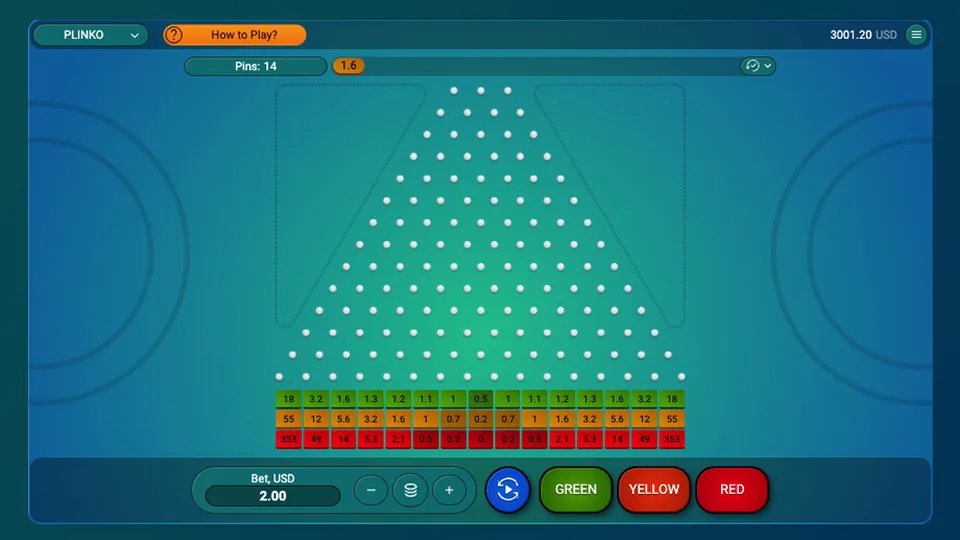
Open Plinko and you see a triangle of pins with a row of cells along the bottom. Each cell carries a coefficient, which is simply a multiplier of your bet. A ball falls from the top, bounces its way down through the pins and settles in one cell. Your return is the stake times that cell's coefficient. That is the whole game.
Plinko belongs to Spribe's Turbo line of short, single-player titles. Spribe links the format to a well-known American television game show, and it reached online casino lobbies after first catching on in crypto casinos. Unlike Aviator or JetX, there is no cash-out button to time and no other players to watch. Once you press a colour, the result is already on its way.
Spribe lists the return to player at 97%, and the outcome of every drop comes from its provably fair seed system. If RTP is a new idea, our RTP guide covers it in a few minutes.
The three settings that matter
Plinko gives you three decisions before each drop, and only three:
- Stake. A preset or your own amount, for example ₦100, adjusted with minus and plus.
- Pins. A dropdown sets how many pins the board has. According to the rules, this changes both the odds and the multipliers on the board.
- Colour. The Green, Yellow and Red buttons each drop a ball of that colour, and each colour has its own line of coefficients at the bottom. A red ball pays from the red line, green from the green line, yellow from the yellow line.
After the ball lands, the result is added to the Last results strip above the board. Spribe presents the colours as levels of complexity, and its how-to-play screen suggests choosing between red, yellow and green for higher odds as the bet multiplier increases. The practical point is that you can read all three lines on the board before you commit a single naira.
How to read a coefficient line
Every time you change the pin count, the board redraws and the lines change. Before betting, look at two numbers on the line you intend to use:
- The edge value. The biggest coefficient, found at the outer cells. This is the best result a drop can give.
- The centre value. The coefficient in the middle cells, where most balls finish. If it is below 1.0x, most drops on that line will cost you part of your stake.
A line with a huge edge value and a low centre value is spiky: many small losses, rare big wins. A line with modest edges and centre values close to 1.0x is smooth. That spread between centre and edge is what volatility means in Plinko, and it is fully visible to you.
Why most balls land in the middle
On a classic pin board, a ball goes left or right at each row with roughly even chances. To reach an outer cell it must go the same way at every single row, while there are many different paths to the centre. The numbers get extreme quickly. On a classic board with 8 rows, a ball reaches one particular edge cell about once in 256 drops and the central cell about 27% of the time. With 12 rows, a single edge cell comes up about once in 4,096 drops. With 16 rows, about once in 65,536.
That is classic board maths, not a published figure from Spribe. Its Plinko turns a seed hash into the result rather than simulating real physics, and Spribe does not publish the odds per cell as text. The board you see follows the same logic, though: the big edge coefficients are there because they are rare. Do not plan a session around hitting them.
Naira examples on an illustrative board
The live coefficients appear only inside the game and depend on colour and pin count. The values below are made up for illustration, to show how the maths works on a ₦500 stake, and are not quoted from a real board.
| Cell coefficient | Paid back on ₦500 | What it means |
|---|---|---|
| 0.3x | ₦150 | You lose ₦350 |
| 0.8x | ₦400 | You lose ₦100 despite a "win" |
| 1.0x | ₦500 | Stake back |
| 2.5x | ₦1,250 | Profit of ₦750 |
| 50x | ₦25,000 | Profit of ₦24,500 |
Look at the second row. The game shows a payout, the ball lights up a cell, and yet you are ₦100 poorer. Ten drops like that in a row feel like ten small wins while your balance falls by ₦1,000. That is the main thing to understand about Plinko: judge a session by your balance, never by how often the screen celebrates.
Fairness you can check
Plinko uses the same provably fair system as Spribe's other games. The operator creates a server seed and shows its hashed form before the round, so it cannot be swapped afterwards. Your client seed is generated on your side and can be changed in the Provably Fair settings. The seeds are combined into a SHA512 hash, and the game turns that hash into the drop result with its own maths. To check a drop, open your bet records from the menu and press the provably fair icon to see the server seed, your seed, the combined hash and the outcome.
Autoplay and how to stop it running away
Autoplay repeats your drop for a chosen number of rounds, and a counter shows how many are left; click it to stop at any time. It offers three stop conditions, and they are worth using every time:
- Stop if cash decreases by an amount, for example ₦2,000 on a ₦5,000 budget.
- Stop if cash increases by an amount, a way to lock in a good run.
- Stop if single win exceeds an amount, so a big edge hit ends the session instead of being fed back in.
Speed is the hidden cost. A shared crash room might give you a few dozen rounds in a quarter of an hour. Plinko on autoplay can give you hundreds. At ₦100 per drop, 300 drops is ₦30,000 wagered, and at 97% the expected cost of that alone is about ₦900. Some casinos disable autoplay, as the rules note.
No system beats the drop
Changing colour or pin count reshapes how returns arrive, but Spribe publishes one RTP for the game, and every drop carries the same 3% edge. Doubling after a losing drop does not help: from ₦100, five losing drops in a row with doubling cost ₦100 + ₦200 + ₦400 + ₦800 + ₦1,600 = ₦3,100, and the next stake is ₦3,200. The expected loss is 3% of everything you wager, so a progression only makes it bigger.
The plan that works for your pocket is dull and effective: a fixed session budget, a flat stake that is a small share of it, one colour and pin setting per session, and a stop when the budget or the time is up.
Connection, malfunctions and the law in Nigeria
A drop settles in about two seconds, so network trouble matters less than in a crash game. The rules still cover it: if the connection drops during an active bet, the game settles it and credits any win, and a hardware or software malfunction voids affected bets and pays, which are refunded.
Gambling in Nigeria is a matter for the states. In November 2024 the Supreme Court held that lotteries and gaming fall under state law, leaving the National Lottery Act in force only in the Federal Capital Territory, and states such as Lagos run their own gaming regulators. Check that an operator is licensed for your state before depositing, and play for real money only if you are 18 or older.
Trying Plinko in the free demo
The demo on this page runs Spribe's official build with demo money. Our free demo guide explains how to make practice count. The best Plinko test is a side-by-side: 50 drops on green, 50 on yellow and 50 on red at the same stake and pin setting, noting the balance after each block. It shows you in minutes how differently the three lines behave.
If you would rather decide when a round ends, try Spribe's Mines, where you cash out after any safe tile, or the live multiplier of Spaceman.
Where to play Plinko with naira

Questions Nigerian players ask
What is the RTP of Plinko by Spribe?
Spribe lists Plinko at 97% RTP, a long-run average across all drops. Over a very large number of drops about ₦97 returns for every ₦100 wagered, but short sessions can land far from that.
What is the difference between green, yellow and red in Plinko?
Each colour is a bet button with its own line of coefficients at the bottom of the board. A red ball pays from the red line, green from green and yellow from yellow. Spribe presents them as levels of complexity.
What does changing the number of pins do?
According to the rules, the pin count changes the odds and the multipliers on the board. After changing it, read the new coefficient lines before you drop, since the values are redrawn.
Why did my balance fall when every drop showed a win?
Many cells pay less than 1.0x. On a ₦500 stake, a 0.8x cell returns ₦400, so you lose ₦100 even though a payout is shown. Always judge a session by your balance.
What is the maximum win in Plinko?
The largest coefficient depends on your colour and pin setting and is shown on the board. Casinos also set a maximum win in the game limits, so check both before playing with naira.
Is Plinko provably fair?
Yes. A hashed server seed is shown before the round and combined with your client seed into a SHA512 hash that produces the result. You can check any drop from your bet records.
Can I play Plinko legally in Nigeria?
Nigerian gambling is regulated by the states since a 2024 Supreme Court judgment, so it depends on where you live. Use only operators licensed for your state, and real-money play is for 18+ only.