On this page
- Plinko in a Canadian casino lobby
- One drop, start to finish
- What the three colours and the pin dropdown do
- Sample drops in Canadian dollars
- Centre cells, edge cells and why they differ
- Checking a drop with provably fair
- The 97% figure and betting systems
- Autoplay, limits and malfunctions
- How Plinko differs from crash games
- Practising in the demo first
- Plinko demo for free
- Questions from Canadian players
Plinko in a Canadian casino lobby
Spribe groups Plinko with its Turbo games: short solo titles that run equally well on a phone or a laptop. The format borrows from an American TV game show, spent a few years as a crypto casino favourite and now appears in plenty of lobbies that accept Canadian dollars. Nothing about it needs a timer or other players. You decide how the ball falls, then watch it land.
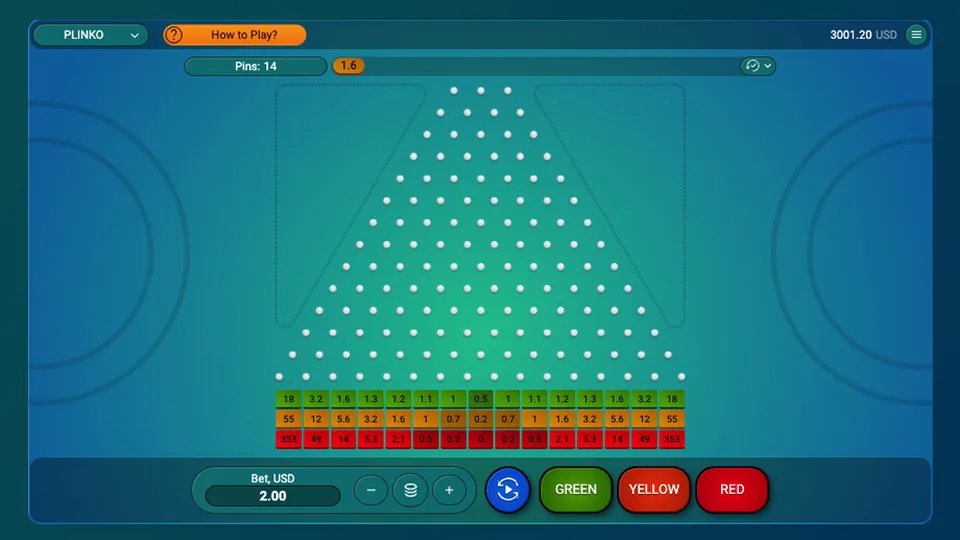
The board is a triangle of pins. Along the bottom runs a row of cells, and each cell carries a coefficient, a multiplier applied to your bet. The ball enters at the top, ricochets off the pins and stops in one cell, and you are paid stake times that coefficient. Some cells pay more than the stake, some return only a part of it.
Spribe lists Plinko's return at 97%. If that number needs unpacking, our guide to RTP walks through it.
A quick legal note: gambling in Canada is a provincial matter. Ontario and Alberta have their own regulated online markets, and this Canadian edition is not written for players in those provinces. You must be 19 in most of the country, or 18 in Alberta, Quebec and Manitoba.
One drop, start to finish
- Stake. Tap a preset value or type your own amount; the minus and plus keys move through the options.
- Pins. Open the dropdown and choose how many pins the board should have. The rules say this alters both the chances and the multipliers.
- Colour. Hit one of the three coloured bet buttons. It releases a matching ball, and each colour pays from its own row of coefficients.
- Fall. The ball bounces down through the pins.
- Payout. When it lands, you receive the coefficient for that cell on the row matching your ball. A green ball never pays from the red row, and so on.
- Record. The result appears in the Last results strip above the board.
A full cycle takes a couple of seconds. That rhythm puts Plinko closer to a slot than to a shared-round crash game.
What the three colours and the pin dropdown do
The how-to-play screen frames the colours as three levels of complexity: as you move toward red, the multipliers on offer get bigger. In practice you are choosing one of three rows printed on the same board, and you can compare all three before spending anything.
The pin dropdown is the second control. More rows of pins mean more bounces and a wider bottom row, and the coefficients change with every setting. Spribe does not publish the tables as text, so build a habit: change the dropdown, then read the rows again. Two numbers tell you most of what you need. The first is the biggest coefficient sitting at the outer edge; the second is what the middle slots pay. A huge edge figure paired with small central values means a spiky, high-volatility row.
Sample drops in Canadian dollars
The coefficients below are hypothetical, picked to show the arithmetic. Real values depend on colour and pin count and are shown only on the board in the game.
| Bet | Cell | Paid back | Outcome |
|---|---|---|---|
| CA$1 | 0.4x | CA$0.40 | Down CA$0.60 |
| CA$3 | 1.0x | CA$3 | Break-even |
| CA$3 | 1.6x | CA$4.80 | Up CA$1.80 |
| CA$0.20 | 250x | CA$50 | Up CA$49.80 |
The first row deserves attention. A cell under 1.0x shows a payout and a small celebration, yet you have lost money on that drop. Run 100 drops at CA$1 where most balls finish on 0.4x or 0.6x cells and the screen will look busy with wins while your balance slides. Judge a session by the balance, never by the number of hits.
Centre cells, edge cells and why they differ
Think of a physical board where every pin sends the ball left or right at fifty-fifty odds: most balls end up near the middle. Reaching the far edge needs the ball to turn the same way at almost every row, which is rare. Boards like this therefore put modest values in the centre and the big multipliers at the edges.
Spribe computes the landing cell from seeds instead of simulating real bounces, but the board follows the same idea: the outer cells are there to be uncommon. Expect most drops to settle in the central band of your row, and treat an edge landing as a bonus you did not plan for, not a target to chase with bigger stakes.
Checking a drop with provably fair
Plinko uses the same fairness framework Spribe applies to its other games. Ahead of each drop the casino commits to a secret server seed by displaying its hash, which rules out a later swap. Your device supplies a client seed that you can replace under Provably Fair settings. Both go into SHA512, and Plinko maps the output to a landing cell using its own formula; Spribe notes that every game has its own conversion.
Verifying an older drop takes a few taps: open your bet records from the menu, choose the drop and tap its fairness icon. You will see both seeds, the SHA512 output and the cell it produced.
The 97% figure and betting systems
A 97% return means that over a very large number of drops, around CA$97 comes back for each CA$100 wagered, and the other CA$3 is the house edge. Switching colours or pins changes how that return is delivered, more small payouts on one setting and rarer big ones on another, but Spribe states a single RTP for the game.
Systems built on raising the stake after a bad drop make things worse, not better. Double from CA$1 after every drop that pays below the stake and five poor drops in a row take you through CA$1, CA$2, CA$4, CA$8 and CA$16, CA$31 in total, with the next drop needing CA$32. The 3% edge never moved during that run; only your total action did, and expected losses scale with total action.
A workable plan is plain: a session budget you can afford to lose, a flat stake that is a small fraction of it, and a firm stop when the budget runs out. If you deposit with Interac, our Interac casino guide also covers setting deposit limits at the cashier.
Autoplay, limits and malfunctions
Autoplay repeats your drop for the number of rounds you choose. A counter shows what is left, and clicking it ends the run at once. The panel offers three stop rules:
- end the run once your balance has dropped by a set amount;
- end it once your balance has grown by a set amount;
- end it when any single payout passes a set amount.
The rules mention that some casinos switch autoplay off. A technical malfunction voids any bets and wins it touches, and those stakes are refunded. Maximum win is set by the casino and shown in the game limits.
How Plinko differs from crash games
Plinko often shares a lobby tab with crash titles, yet the two play very differently:
- No exit button. Once released, the ball is out of your hands. Crash games, by contrast, are entirely about when you bail out.
- Something back on bad drops. Low cells give some of the stake back; a missed crash cash-out takes all of it.
- Payout map in plain sight. The best and worst outcomes are printed on the board before each drop.
- Your own pace. There is no shared countdown, so you drop whenever you are ready.
Calmer is not the same as cheaper. With autoplay running, you can fit far more bets into an hour than any crash room would allow.
Practising in the demo first
The demo here loads Spribe's official client with play credit. Our free demo guide explains how to test a game properly. For Plinko, drop 50 balls per colour while keeping the stake and pin count fixed, then compare the balances. Nothing teaches the difference between rows faster.
Before you play in CAD, open the rules at your casino and confirm the RTP and bet limits. Our Canadian casino rankings list sites that take Canadian dollars. If you would rather choose when to stop mid-round, look at Spribe's Mines or the plane in Aviator.
Where to play Plinko in Canadian dollars

Questions from Canadian players
What RTP does Plinko by Spribe have?
Plinko's published RTP from Spribe is 97%. It is a theoretical figure measured over a huge number of drops, so a short session in Canadian dollars can finish far above or below it. Use it to understand the house edge, not to predict results.
Green, yellow or red ball: which should I pick?
Each colour pays from its own row of coefficients along the bottom of the board. In Spribe's wording they are three complexity levels, with the multipliers on offer growing as you move toward red. Compare the three rows before you drop.
Why change the number of pins in Plinko?
The rules say the pin count changes both the odds and the multipliers. More pins mean more bounces and a different set of coefficients, so read the rows again every time you switch the dropdown.
Can I check that a Plinko drop was fair?
Yes. The casino seed is visible only as a hash until the drop; afterwards that seed plus your own go through SHA512, and the output picks the cell. Open your bet records and press the provably fair symbol to see every value.
Is a 0.5x result a win or a loss?
It is a partial loss. At CA$2, a 0.5x cell pays back CA$1, so the drop costs you CA$1 even though the game shows a payout. Many low cells in a row can drain a balance quietly.
Does any strategy beat Plinko?
No. Colour and pin choices leave the house edge untouched. Doubling after bad drops only increases the amount wagered, and with it the expected loss. A flat stake and a fixed budget are the sensible approach.
Can players in Ontario or Alberta use this guide?
This Canadian edition is not aimed at Ontario or Alberta, which run their own regulated online markets. In the rest of Canada the minimum age is 19, or 18 in Quebec and Manitoba.