On this page
- What you see when Plinko loads
- A single drop, step by step
- Green, yellow and red explained
- What the pin dropdown changes
- Sample payouts in shillings
- Why most balls land near the middle
- Checking a drop with the seeds
- The house edge over a session
- Autoplay and sensible limits
- Signal sellers and Plinko patterns
- Kenyan rules, deposits and 18+
- Practising in the free demo
- Plinko free demo
- Questions from Kenyan players
What you see when Plinko loads
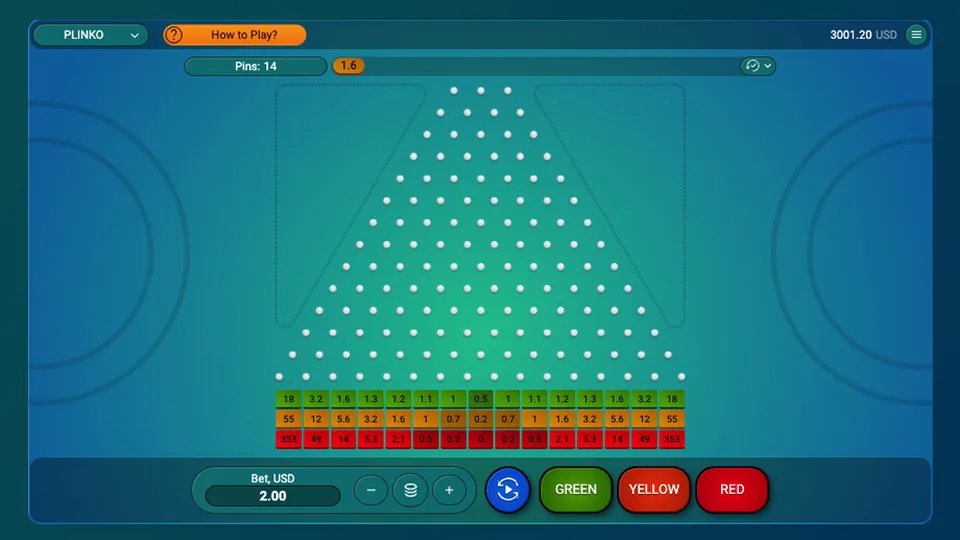
The screen holds a pyramid of pins with a row of cells along the bottom. Each cell shows a coefficient, the figure your stake gets multiplied by. You release a ball from the top, it ricochets off pin after pin and comes to rest in one cell. Your payout is your stake times that cell's figure, and the round is over.
Plinko belongs to Spribe's Turbo range, a set of short solo games designed for quick play on any phone. Spribe links the format to a well-known American TV game show; it then found a following on crypto sites before arriving in regular casino lobbies. Unlike Aviator, there is no shared room and no exit to time. Once the ball leaves the top, nothing you do can change where it ends.
The published return sits at 97%, and Spribe's provably fair seeds generate each result. If you want to understand what that percentage really promises, our RTP guide walks through it.
A single drop, step by step
- Pick the amount. Use a ready amount or key in one, say KSh 50, and nudge it with the minus and plus buttons.
- Set the pins. A dropdown sets how many pins stand on the board. According to Spribe, that changes the odds as well as every multiplier along the bottom.
- Choose a colour. Press Green, Yellow or Red. Each button has its own row of coefficients under the board.
- Watch it fall. A ball of that shade tumbles down, knocking from pin to pin until a cell catches it.
- Get paid. The ball pays from its own colour row: a red ball from the red line, a yellow ball from the yellow line, a green ball from the green line.
- Results strip. The coefficient you hit joins the Last results row above the board.
A drop takes about as long as a slot spin, which is exactly why the game feels so light. It is also why a shilling budget can disappear faster than in a crash room, where you wait several seconds between rounds.
Green, yellow and red explained
Spribe describes the colours as three difficulty levels, with the in-game help linking a riskier colour to a bigger possible multiplier. On the board, that means three separate rows of coefficients, all visible at the same time, so you can compare them before every drop.
A practical way to read them: look at the biggest figure at each end of a row, then at the figures in the middle. A row with tall edges and small middle values is the spiky choice, where most drops return little and the odd one pays a lot. A row with a flatter shape returns something closer to your stake more often. That trade-off is what volatility means, and Plinko is one of the few games that prints it right in front of you.
What the pin dropdown changes
The number of pins is your second control. More rows mean more bounces on the way down, more cells at the bottom and a fresh set of coefficients for every colour. Spribe does not publish those values as text; the game server sends them to the board. So the habit to build is simple: change the pin setting, stop, read all three rows again, and only then drop. Skipping that step is how players end up on a far riskier line than they intended.
Sample payouts in shillings
Because the live coefficients depend on colour and pins, the figures below are illustrative only, picked to show how the sums work rather than copied from a real board.
| Stake | Cell figure | Paid back | Net result |
|---|---|---|---|
| KSh 100 | 0.3x | KSh 30 | KSh 70 down |
| KSh 200 | 1.1x | KSh 220 | KSh 20 up |
| KSh 50 | 3.0x | KSh 150 | KSh 100 up |
| KSh 20 | 120x | KSh 2,400 | KSh 2,380 up |
Notice the first row. A cell below 1.0x still pays something, so the screen flashes a payout even though you lost KSh 70. That is the biggest difference from a crash game, where a missed exit loses the full stake, and it is why a Plinko balance can slide downward while almost every drop appears to win. Judge a session by your balance, never by how often the screen celebrates.
Why most balls land near the middle
On a real pin board, a ball with an even chance of going left or right at each row tends to finish near the centre. Reaching an outer cell needs many bounces in the same direction, which is rare. That is why boards like this put modest figures in the middle and the large ones at the edges.
Spribe's version draws each result from a seed hash rather than real physics, but the layout follows the same logic: the edge cells exist to be uncommon. Expect most of your drops to settle in the central part of your row. An edge hit is a pleasant surprise, not something to build a session around.
Checking a drop with the seeds
Plinko uses the same provably fair approach as Spribe's crash title. Before the round, the operator creates a server seed and shows only its hash, so the seed cannot be swapped after you bet. Your side supplies a client seed, which you can replace in the Provably Fair settings at any time. The seeds are combined and run through SHA512, and Spribe says each game turns that hash into a result with maths suited to that particular game.
To audit, open the bet records from the menu and press the fairness icon next to a drop. A panel lists the operator value, your own seed, the merged hash and the coefficient that came out of it.
The house edge over a session
With a 97% RTP, about KSh 97 comes back for every KSh 100 staked across a long run, and KSh 3 stays with the casino. Changing colour or pins reshapes how that return arrives, with steadier small payouts on some settings and rarer large ones on others, but Spribe publishes one RTP for the game.
Scale it up. Three hundred drops at KSh 20 make KSh 6,000 wagered, and the average cost of that session is about KSh 180. At autoplay speed, three hundred drops can come and go during a single matatu ride home.
Doubling does not rescue it either. Double after every drop that pays less than your stake, starting from KSh 50, and five such drops in a row cost 50 + 100 + 200 + 400 + 800 = KSh 1,550, with KSh 1,600 needed next. Each drop keeps the same 3% edge, so a larger total wager only grows the expected loss.
Autoplay and sensible limits
Autoplay fires the same drop again and again for the count you pick, with a counter showing what is left; tap it to stop whenever you like. The panel lets you add stops that work as personal limits:
- end the run after your balance falls by an amount you choose;
- end it after your balance rises by an amount you choose;
- end it when one drop pays more than an amount you choose.
A sensible setup on a KSh 2,000 budget is a KSh 20 flat stake with a KSh 700 loss stop. The rules note that some casinos switch autoplay off entirely. If a hardware or software fault strikes, affected bets and payouts are void and stakes are refunded.
Signal sellers and Plinko patterns
You may come across groups offering Plinko tips: a best colour for the evening, a lucky pin count, a pattern in the Last results row. None of it holds up. Each drop is generated from seeds that include a server value hidden until after the round, so past results carry no information about the next ball. Anyone charging for signals is selling you nothing, and anyone asking for your login or a deposit through their link is a risk to your account. Keep your choices to stake size, colour and the limits above.
Kenyan rules, deposits and 18+
Online gambling in Kenya is regulated under the Gambling Control Act 2025, with the Gambling Regulatory Authority of Kenya in place of the former Betting Control and Licensing Board. Use operators licensed to serve Kenya, and play only if you are 18 or older. Payment options such as M-Pesa or Airtel Money vary between casinos, so confirm them in the cashier before you sign up. Set your weekly amount before the first deposit, and leave chama savings and household money out of it.
Practising in the free demo
This page carries Spribe's official build with play money. Our free demo guide explains how to get useful information out of practice. A good drill: give each colour 50 drops at an identical stake and pin count, then line up the three ending balances side by side. That one exercise tells you more about each row than any amount of reading.
Moving to real shillings? Check the RTP and stake limits in the rules of your casino's version first. Players who like deciding when to quit inside a round usually enjoy Spribe's Mines, while JetX offers crash flights with up to four bets.
Where to play Plinko in shillings

Questions from Kenyan players
What is the RTP of Plinko in Kenya?
The published figure is 97% RTP, a theoretical average over a very large number of drops, so any single session can finish well above or below it. Confirm the figure in the rules screen of your casino's version before playing for real shillings.
Which ball colour should I choose in Plinko?
Each colour pays from its own row, and Spribe treats the three as difficulty levels. Compare the edge and middle figures of each row on the board: tall edges with small middle values mean a spikier ride, a flatter row means steadier returns.
What does changing the number of pins do?
According to the rules, a new pin count brings new odds and new multipliers. More rows bring more bounces, more cells and new coefficients for all three colours, so read the rows again after every change.
Why did I lose money when Plinko showed a win?
A cell below 1.0x returns only part of your stake. For example, 0.3x on a KSh 100 drop pays back KSh 30, so you are KSh 70 down even though a payout appears on screen.
Is Spribe Plinko provably fair?
Yes. Before each drop you can see a hash of the operator seed; that seed is later merged with yours and passed through SHA512 to produce the outcome. The fairness icon in your bet records shows every step.
Do Plinko signals or lucky patterns work?
No. Each drop comes from seeds that include a server value hidden until after the round, so earlier results reveal nothing about the next ball. Paid signals and pattern tips cannot beat the 3% edge.
What is the biggest win in Plinko?
The top figure changes with colour and pins, and you can read it on the board. Each casino also sets a maximum win, listed in the game limits. Check both before you stake real money.