On this page
- What Plinko is
- How a drop works, step by step
- Colours, pins and risk
- Worked payout examples
- Why the middle and the edges behave differently
- Provably fair results
- RTP and why no system beats it
- Autoplay and the other rules
- Plinko compared with crash games
- Trying Plinko in the free demo
- Plinko free demo
- Frequently asked questions
What Plinko is
Plinko comes from Spribe's line of Turbo games, short single-player titles built for quick rounds on any device. Spribe traces the format back to a popular American TV game show; after a second life in crypto casinos, it moved into mainstream online casino lobbies. There is no timer, no other players to watch and no cash-out decision mid-round. You choose how to drop the ball, and physics-style animation does the rest.
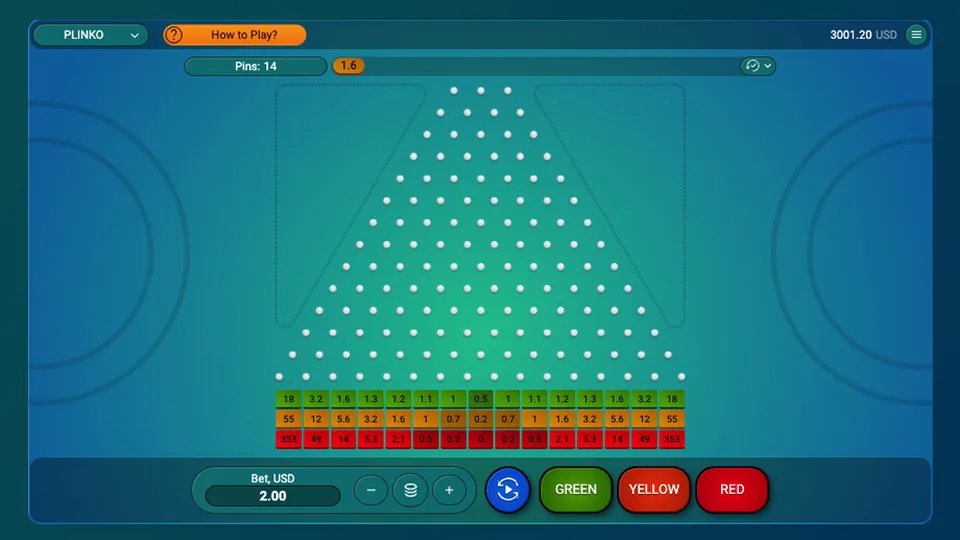
The board is a pyramid of pins. At the bottom sits a row of cells, each carrying a coefficient, which is a multiplier of your bet. The ball falls from the top, is deflected by the pins and settles in one cell. Your win is the stake times that cell's coefficient. Some cells pay more than you bet, others return only part of it.
Spribe lists Plinko's return to player at 97%, and every drop is generated with its provably fair system. If RTP is a new term for you, our RTP guide explains how to read it.
How a drop works, step by step
- Set the stake. Pick a preset amount or enter your own, and use minus and plus to move between options.
- Choose the pins. Select the number of pins from the dropdown. According to the rules, this changes both the odds and the multipliers on the board.
- Pick a colour. Press the Green, Yellow or Red bet button. Each colour has its own line of coefficients at the bottom of the board.
- The drop. A ball of that colour falls from the top, bounces through the pins and lands in a cell.
- Settlement. The round ends when the ball hits the cell. A red ball pays from the red line, a green ball from the green line and a yellow ball from the yellow line.
- Last results. The outcome is added to the Last results strip above the board.
That is the full loop. A single drop takes a couple of seconds, which is why Plinko feels closer to a slot spin than to a crash game.
Colours, pins and risk
Spribe presents the three colours as levels of complexity. The how-to-play screen puts it simply: pick red, yellow or green tiles for higher odds as the bet multiplier increases. In practice, each colour gives you a different line of coefficients on the same board, and you can see all three before you drop.
The pin count is the second dial. More rows of pins mean more bounces, more cells at the bottom and a different set of coefficients. The exact values change with each setting, so the best habit is to switch the dropdown and read the new lines before you bet. Look at two things: the size of the largest coefficient at the edges and the value of the cells near the middle. That pair tells you how spiky a colour is, which is the essence of volatility.
Worked payout examples
Spribe shows the live coefficient values only inside the game, and they depend on colour and pin count. The figures below are illustrative, chosen to show the math rather than quoted from a specific board.
| Stake | Cell coefficient | Returned | Result |
|---|---|---|---|
| 2.00 | 0.5x | 1.00 | Loss of 1.00 |
| 2.00 | 1.0x | 2.00 | Stake back |
| 2.00 | 1.85x | 3.70 | Profit of 1.70 |
| 0.50 | 100x | 50.00 | Profit of 49.50 |
The pattern to notice is that a coefficient below 1.0x is still a partial return, not a total loss. That is a key difference from crash games, where a missed cash-out loses the whole stake. It also means a Plinko session can drift down slowly even while the screen shows a win on almost every drop. Watch your balance, not the number of hits.
Why the middle and the edges behave differently
On a classic pin board, a ball that bounces left or right at each row with even chances tends to finish near the centre, and reaching an outer cell requires a long run of bounces in the same direction. That is why boards like this usually place modest coefficients in the middle and the big ones at the edges.
Spribe's version generates each result from its seed hash rather than from real physics, but the board you see follows the same logic: the big edge cells are there to be rare. Expect most drops to land in the central area of your chosen line, and treat edge hits as occasional events rather than something to chase.
Provably fair results
Spribe's provably fair system applies to Plinko as it does to its crash game. The operator generates a server seed and publishes its hashed version before the round, so it cannot be changed afterwards. Your client seed is generated on your side and can be changed in the Provably Fair settings. When the round starts, the seeds are combined into a SHA512 hash, and the result is derived from it. Spribe notes that each game turns the hash into a result with its own math, suited to that game.
To check a drop, open your bet records from the game menu and press the provably fair icon. You will see the server seed, your seed, the combined hash and the outcome.
RTP and why no system beats it
At 97% RTP, about 97 units come back for every 100 wagered over a long run, and 3 units are the house edge. Changing the colour or the pin count reshapes how that return arrives, with more small hits on some settings and rarer big ones on others, but Spribe publishes a single RTP for the game.
Progressions do not help. If you double your stake after each drop that returns less than the stake, the series 1, 2, 4, 8, 16 costs 31.00 after five losing drops, and the next stake is 32.00. Each drop still carries the same 3% edge, so the expected loss is 3% of everything wagered. Raising the total wagered only raises the expected loss.
A sensible plan is a fixed session budget, a flat stake that is a small share of it, and a hard stop when the budget is gone.
Autoplay and the other rules
Autoplay repeats your drop for a set number of rounds, and the remaining count shows on a counter you can click to stop at any time. The panel offers stop conditions that act as limits:
- Stop if cash decreases by a chosen amount.
- Stop if cash increases by a chosen amount.
- Stop if single win exceeds a chosen amount.
Some casinos disable autoplay, as the rules note. In the event of a hardware or software malfunction, affected bets and payouts are void and bets are refunded.
Plinko compared with crash games
Plinko often sits in the same casino lobby section as crash titles, but it plays differently in ways that matter for your budget:
- No timing decision. Once the ball drops, nothing you do changes the outcome. In a crash game your cash-out point is the whole decision.
- Partial returns. Low cells give back part of the stake, while a crash round either pays in full at your multiplier or loses everything.
- Visible payout map. Every possible coefficient is printed on the board before you bet, so you always know the best and worst outcome of a drop.
- Solo pace. You drop when you are ready instead of waiting for a shared round to start.
That makes Plinko a calmer choice, but not a cheaper one. At rapid-fire autoplay speed, the number of bets per hour can be far higher than in any shared crash room.
Trying Plinko in the free demo
The demo above loads Spribe's official build with demo money. Our free demo guide covers how to test a game properly. In Plinko, run 50 drops on each colour at the same stake and pin setting and compare where your balance ends up. It is the fastest way to see what each line feels like.
In your casino's version, open the rules to confirm the RTP and the bet limits. If you want a game where you decide when to stop mid-round, try Spribe's Mines, or the crash format in Aviator.
Where to play Plinko for real money

Frequently asked questions
What is the RTP of Spribe Plinko?
Spribe lists Plinko at 97% RTP. That is a long-run theoretical average across all drops. Short sessions can land well above or below it, so treat it as a guide to the game's edge, not a session forecast.
What do the green, yellow and red balls mean in Plinko?
They are three bet buttons, each with its own line of coefficients at the bottom of the board. A red ball pays from the red line, a green ball from the green line and a yellow ball from the yellow line. Spribe presents them as levels of complexity.
What does the number of pins change?
According to the rules, the pin count changes the game's odds and the bet multipliers on the board. After changing it, read the new coefficient lines before you drop.
Is Plinko by Spribe provably fair?
Yes. A hashed server seed is published before the round and combined with your client seed into a SHA512 hash that produces the result. You can check any drop from your bet records by pressing the provably fair icon.
What is the maximum win in Plinko?
The highest coefficient depends on your colour and pin setting and is shown on the board. Casinos also set a maximum win, which appears in the game limits. Check both before playing for real money.
Can a coefficient below 1x count as a win?
A coefficient below 1.0x returns part of your stake. For example, 0.5x on a 2.00 bet returns 1.00, so the drop costs you 1.00 even though a payout is shown.
Is there a strategy that beats Plinko?
No. Every drop carries the same house edge, and changing colour or pin count only reshapes how results arrive. Doubling after losses raises the total wagered and the expected loss.