On this page
- Plane, multiplier, one decision
- From betting window to fly-away in five beats
- Seconds on the clock at each target
- Rand payouts at common exits
- Splitting a round across two panels
- Automation, limits and a dropped signal
- Checking a crash point with the seeds
- Where the 3% goes and why doubling fails
- The Limits screen, the law and 18+
- A practice plan for the free demo
- Aviator demo for free
- Questions from South African readers
Plane, multiplier, one decision
Aviator first went live in February 2019. Spribe's game helped carry crash titles from niche crypto lobbies into mainstream online casino menus around the world. A later Aviator 2.0 build trimmed the client so it opens faster, which matters if you are on a prepaid data bundle or a patchy signal after load-shedding has knocked the tower out.
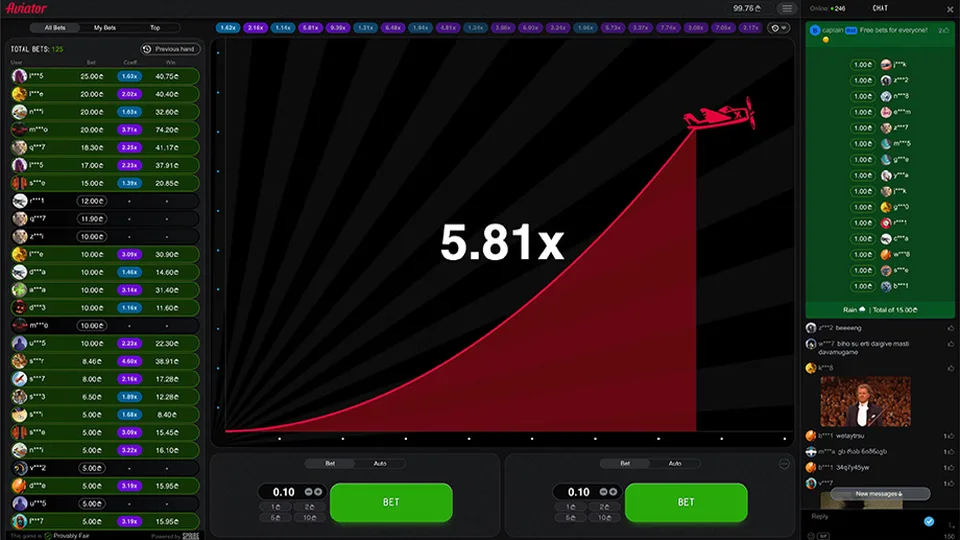
Nothing on screen spins. You see a runway, a red plane and a number. When the round starts the plane climbs and the number grows from 1.00x. At a moment fixed before take-off, the plane disappears. Press Cash Out first and your stake is multiplied by whatever the counter showed. Wait too long and that stake is gone in full. There is no partial refund and no bonus round to rescue it.
Spribe quotes a return to player of 97%. If that percentage is unfamiliar, our RTP explainer breaks down where such numbers come from and why they only hold across enormous samples of play.
From betting window to fly-away in five beats
- Place your stake. While the previous round clears, enter an amount in one or both panels, tap a preset or nudge it with the plus and minus keys. Cancelling is allowed right up to take-off.
- Outcome locked. Before anyone has bet, the operator has already produced this round's server seed and displayed a SHA256 fingerprint of it. Seeds belonging to the three quickest bettors get added.
- Lift-off. The counter starts at 1.00x and accelerates along a fixed curve published in the rules.
- Your exit. Hit Cash Out on a panel, or let the automatic exit fire at your preset value. Payout equals stake times the live figure at that instant.
- Gone. At the sealed crash point the plane leaves the screen. Anything still riding loses, and the final figure joins the strip of recent rounds along the top.
Seconds on the clock at each target
The rules define growth as floor(100 × e^(0.000083 × ms)) / 100, with ms counting milliseconds since lift-off. Plug in a few targets and the timing becomes concrete:
| Target | Seconds since lift-off (rounded) |
|---|---|
| 1.5x | roughly 5 |
| 2x | just over 8 |
| 3x | a little over 13 |
| 5x | close to 19.4 |
| 10x | near 28 |
| 100x | around 55 |
A low target is decided within the time it takes to sip your coffee. A three-figure target means nearly a minute of staring at the plane, which is where impulsive clicks tend to creep in. Knowing the clock helps you pick a target you can actually sit through calmly.
Rand payouts at common exits
| Stake | Exit | Paid back | Net result |
|---|---|---|---|
| R10 | 1.20x | R12 | +R2 |
| R20 | 1.85x | R37 | +R17 |
| R50 | 3.00x | R150 | +R100 |
| R5 | 25.00x | R125 | +R120 |
| R20 | missed | R0 | −R20 |
The last row is the one people forget to budget for. Two details from the rules also catch beginners out. When a round ends at 1.25x, the highest value the plane genuinely reached was 1.24x. And an automatic exit set exactly at the crash value does not pay: the counter must climb past your target, so a preset of 1.25x loses in a round that ends at 1.25x.
Splitting a round across two panels
Tap the plus symbol on the first bet panel and a second appears beneath it. Both work independently, each with its own amount, button and automatic settings. Many players pair a cautious exit with a speculative one.
Try R10 on each panel. Panel one exits automatically at 1.50x, panel two waits for you to press at 4.00x. If the round runs to 5.10x and you catch your target, you collect R15 plus R40, so R55 on R20 risked. If the plane leaves at 2.60x, only the first panel pays: R15 back, a R5 loss on the round. If it disappears at 1.08x, the full R20 is lost. Splitting changes the shape of each round, never the expected return on either stake.
Automation, limits and a dropped signal
Each panel has an Auto tab. The automatic exit closes a stake once the multiplier passes your number, so a slow thumb or a laggy phone cannot cost you a target. Auto Play repeats your stake for a chosen number of rounds, and it will not start until you pick a minimum of one stop rule:
- stop once your balance has fallen by a set amount, effectively a loss limit;
- stop once your balance has risen by a set amount, locking in a profit;
- stop when one win is bigger than a set amount.
Switching on Auto Play without an automatic exit still leaves the Cash Out press to you every round, so fully hands-free play needs both. Suppose your connection dies mid-flight, perhaps when the inverter gives up halfway through a stage. Spribe's rules then close the live stake at whatever multiplier the plane had reached and pay that amount into your balance. A genuine hardware or software fault voids the bets involved and refunds them.
Checking a crash point with the seeds
Aviator does not leave the outcome to a single hidden roll. Ahead of every flight, the operator generates a 16-character random server seed and publishes just its SHA256 hash, so it cannot be quietly swapped. Every player also holds a client seed, editable under the Provably Fair settings. When betting closes, that server seed is stitched together with seeds from the three earliest bettors, SHA512 hashes the combined string, and the crash value is derived from the result.
Auditing a past flight is quick. Find it under My Bets, or in the Top tab, then press the small fairness symbol next to it. A window reveals the server seed, all three client seeds, the SHA512 output and the multiplier it produced. Keen for your personal seed to count? Place your bet among the first three in that round. Separate Aviator rooms each run their own seeds and produce outcomes independently.
Where the 3% goes and why doubling fails
A video slot gets its return from reel layouts and a pay table. Aviator's comes from how crash values are spread. The rules spell it out: at 97% theoretical return, around 3 flights per 100 finish at the very start, before anyone can exit. That instant loss is the house's slice.
The 97% applies whichever target you pick. Exiting at 1.20x wins often and pays little; holding for 15x wins seldom and pays plenty. Over thousands of rounds both settle near R97 returned per R100 staked. What you are really selecting is volatility, the swing of your balance, not a better price.
Doubling after every loss looks clever at a 2.00x target. Begin at R10, then R20, R40, R80 and R160. Five misses in a row have cost R310, and the sixth stake must be R320 just to end R10 up. Runs like that arrive sooner or later, and the table limit or your balance halts the chain first. Each stake also carries the same 3% edge, so wagering more only enlarges the expected loss. Flat stakes, a fixed session amount and a stop rule in Auto Play do far more for you.
The Limits screen, the law and 18+
Open the game menu and find Limits. It lists the minimum and maximum stake and the highest win available at that operator. These are set per operator, so they differ from lobby to lobby, and once a win hits the cap the game exits for you automatically. On the left, the Live Bets column fills with everyone's wagers for the flight in progress. Biggest wins and multipliers are ranked under Top for the day, the month and all time, while chat runs down the right edge.
On the legal side, the National Gambling Act 2004 does not authorise online casino games in South Africa; the legal online option is sports betting with a provincially licensed bookmaker. We do not encourage anyone to break local law and never suggest VPNs or ways around blocks. Gambling is for adults 18 and over, and the demo on this page runs on play credits only.
A practice plan for the free demo
The official Spribe build loads above with play credits, so mistakes cost nothing. Our free demo guide covers the limits of practice mode as well as its uses. For Aviator, run three tests. First, watch how long your chosen target really takes. Second, set an automatic exit and see how it behaves when the plane leaves right at your number. Third, play fifty rounds at the stake you would use with real money and note how deep the worst losing run goes.
Curious about similar formats? JetX lets you spread up to four stakes across a single flight, while Spaceman allows you to bank half a stake mid-flight. If a ticking clock is not your thing, Spribe's Mines lets you stop whenever you like.
Where Aviator is offered

Questions from South African readers
What return to player is listed for Aviator?
Spribe publishes 97%. According to the in-game rules, around 3 flights out of 100 end the second the plane departs. Treat 97% as a long-run figure covering every possible exit target; one evening of play can finish well above or below it.
Is it possible to verify an Aviator round myself?
It is. A hash of the server seed is visible before betting closes. That seed is then combined with seeds from the three first bettors and run through SHA512, which fixes where the plane departs. Pick a round in My Bets and press the fairness symbol to inspect the lot.
Can I play two stakes in one Aviator round?
Yes. A plus symbol on the first panel adds a second. The two run apart from each other with separate amounts, buttons and automatic exits, so you could take R15 from one stake at 1.50x and let a second R10 ride for a bigger target.
What happens if the plane crashes exactly on my auto cash out value?
The stake loses. The multiplier has to go beyond your preset number for the automatic exit to pay. A round that ends at 1.25x only ever reached 1.24x, so a 1.25x preset does not pay in that round.
Is Aviator legal to play for real money in South Africa?
Under the National Gambling Act 2004, online casino games are not authorised in South Africa; licensed online betting is limited to sports betting with provincially licensed bookmakers. We never advise VPNs or bypassing blocks. The demo here uses play credits, and gambling is strictly 18+.
What is the biggest possible win in Aviator?
There is no single answer, because every operator chooses its own cap on wins and multipliers. Look under Limits in the game menu. When a payout reaches that ceiling, Aviator closes the stake automatically.
Does doubling my stake after a loss beat Aviator?
No. Starting at R10 and doubling, five straight misses cost R310 and the next stake must be R320 to finish R10 ahead. Every bet carries the same edge, so betting more only raises the expected loss.