On this page
- The game on one screen
- One round from bet to fly-away
- How fast the number climbs
- Payouts worked out in shillings
- Running the second bet panel
- Auto Play and its stop limits
- Seeds and the fairness check
- Predictor apps and signal groups
- The 3% edge in shillings
- Limits, the law in Kenya and 18+
- Practise first in the free demo
- Aviator free demo
- Questions from Kenyan players
The game on one screen
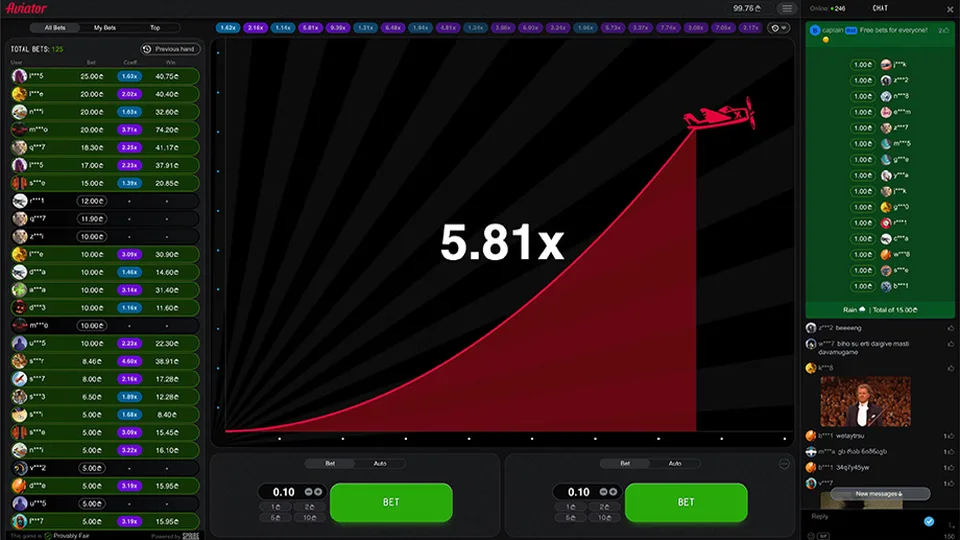
Aviator has no reels, no symbols and no bonus round. The whole game is a red plane, a curve and a number. When a round begins the number reads 1.00x and starts rising as the plane gains height. At a point fixed before take-off, the plane flies off the screen. If you pressed Cash Out in time, your stake is paid back multiplied by the figure showing at that moment. If you were still waiting, the stake stays with the house.
Spribe says Aviator went live in February 2019. A later rebuild, Aviator 2.0, loads faster and uses a lighter client, which is good news if you play on a mid-range Android phone and watch every megabyte of your Safaricom data bundle. Spribe quotes a 97% return, and each crash point comes from a provably fair seed process that you can audit yourself. If the RTP figure is new to you, read our RTP guide first; it explains why the number only holds across a very large sample of rounds.
One round from bet to fly-away
Here is a single round played with a KSh 100 stake and an automatic exit at 2.00x.
- The betting gap. Between flights you type 100 into the bet panel or tap a preset. Open the Auto tab, switch on Auto Cash Out and enter 2.00. Until the plane moves, you can still cancel.
- Seeds are fixed. The server seed for this round already exists, and its SHA256 hash was on display beforehand. Whoever bets first, up to three players, contributes a client seed to the mix.
- Lift. The counter leaves 1.00x and keeps climbing.
- Your exit. The moment the plane passes 2.00x, the game closes your bet and KSh 200 drops into your balance: your KSh 100 back plus KSh 100 profit.
- The plane goes. It vanishes at its preset value, say 3.47x, and that result joins the strip of recent rounds at the top.
Had the plane gone at 1.88x, the KSh 100 would have been lost. Every round reduces to the same yes or no: does the multiplier get past your number?
How fast the number climbs
Spribe's rules define the climb with an exponential formula: the value on screen is e raised to the power 0.000083 times the milliseconds since take-off, multiplied by 100, rounded down and divided by 100 again. Solving it for common targets gives these timings.
| Target | Time after take-off | What that means for you |
|---|---|---|
| 1.30x | about 3.2 seconds | Over almost before you blink |
| 2.00x | about 8.4 seconds | Enough time to start second-guessing |
| 5.00x | about 19.4 seconds | A real test of patience |
| 10.00x | about 27.7 seconds | Most of the room has cashed out |
| 100.00x | about 55.5 seconds | Close to a full minute of watching |
Short targets settle in seconds, so you can play a lot of rounds in a short lunch break, and the money you wager per hour grows with that pace. Long targets leave room for nerves, and a plan dropped halfway through a flight usually costs more than the plan itself.
Payouts worked out in shillings
Your return is always the stake times the multiplier at the moment of exit. Four examples at typical Kenyan stake sizes:
| Stake | Cash out at | Paid back | Profit |
|---|---|---|---|
| KSh 50 | 1.60x | KSh 80 | KSh 30 |
| KSh 200 | 2.40x | KSh 480 | KSh 280 |
| KSh 1,000 | 1.15x | KSh 1,150 | KSh 150 |
| KSh 20 | 60.00x | KSh 1,200 | KSh 1,180 |
One rule surprises many new players. If the plane leaves at exactly your auto value, the bet loses. Spribe illustrates it with a round that ends at 1.25x: the last value the plane actually reached was 1.24x, so an auto exit set to 1.25x pays nothing. Matching your figure is not enough; the plane must climb past it.
Running the second bet panel
A small plus sign in the corner of the bet area opens a twin panel. The two never interfere: different amounts, different exit buttons, different automatic targets, so one flight can carry two separate plans. A typical pairing is a cautious bet with an automatic exit plus a smaller bet you are prepared to lose.
Say KSh 300 sits on panel one with Auto Cash Out at 1.40x, and KSh 100 sits on panel two with a manual target of 8.00x. Total staked: KSh 400.
- Plane reaches 9.50x and you press the second button at 8.00x: KSh 420 plus KSh 800, so KSh 1,220 comes back.
- Plane leaves at 2.20x: only the cautious bet pays, KSh 420 back, a gain of KSh 20 on the round.
- Plane leaves at 1.05x: both bets are lost, KSh 400 gone.
Both panels are ordinary bets carrying the same 97% return. Splitting your stake changes how the round feels, not what it is worth on average.
Auto Play and its stop limits
Auto Play repeats your bet for as many rounds as you set, yet it refuses to begin without at least one stop rule in place. You can end the run when your balance falls by a set amount, when it rises by a set amount, or when one single win goes above a set amount. On a KSh 3,000 session budget, a KSh 1,000 loss stop means one bad patch cannot take the lot.
Auto Play only places bets. With Auto Cash Out left off, collecting each win remains your job. For hands-free play, both switches must be on.
Connection matters too. On a matatu or a boda ride the signal comes and goes, so Spribe's disconnection rule is worth knowing: lose the link mid-flight with money riding, and Spribe closes that bet at whatever multiplier was showing, paying the amount into your balance. A hardware or software fault voids the affected bets and refunds them. An auto target is still the safest way to make sure your exit happens when the network does not cooperate.
Seeds and the fairness check
Each crash point is settled before take-off from four inputs. The operator generates a random server seed of 16 characters and publishes its SHA256 hash in advance, which rules out swapping it later. Client seeds from the first three bettors in the round are then added. All of that is joined and fed into SHA512, and that hash decides where the plane leaves.
Auditing takes a few taps: find the round under My Bets, or on the Top tab, and press the small fairness icon. A window lists the operator seed, each of the three client seeds, the joined hash and the final value. You can change your own client seed in the Provably Fair settings, but it only feeds into a round when you are among the first three to bet. Aviator runs several rooms, and every room has its own seeds and its own results.
Predictor apps and signal groups
Telegram and WhatsApp groups selling Aviator signals, and apps claiming to predict the next crash, are everywhere. Ignore them. The crash point depends on a server seed that stays hidden until the round ends and on seeds from other players that nobody can know in advance. No app can read it, and no sequence in the recent results strip points to the next value. Many of these offers exist only to take a subscription fee, your login details or a deposit through their own link. Keep your account details and your money away from them.
The 3% edge in shillings
A slot builds its RTP from reels and a paytable; Aviator builds it from how crash points are spread. The rules say that with a 97% theoretical return, about 3 rounds out of every 100 end with the plane leaving right at the start. That instant loss is the house margin, and every exit target has to live with it.
Put it in shillings. Five hundred rounds at KSh 50 means KSh 25,000 wagered, and at 97% the average cost of that session is about KSh 750, whether you always exit at 1.20x or always wait for 20x. Your target only sets the volatility: low targets bring small, frequent wins, high targets bring long dry spells and the odd big hit.
That is also why doubling after a loss fails. Start at KSh 50 with a 2.00x target and lose five times running: KSh 50, 100, 200, 400 and 800 add up to KSh 1,550 gone, and the sixth bet must be KSh 1,600 just to finish KSh 50 up. Each of those bets carries the same 3% edge, so a bigger total wager only means a bigger expected loss. Flat stakes sized to your budget hold up far better.
Limits, the law in Kenya and 18+
The game menu has a Limits screen showing the minimum bet, maximum bet and maximum win at your casino. These are operator settings, so they differ between sites, and a win that hits the cap is cashed out automatically. Check them before your first real-money round.
Betting in Kenya is now governed by the Gambling Control Act 2025, under which the Gambling Regulatory Authority of Kenya took over from the old Betting Control and Licensing Board. Play only with operators licensed to serve Kenya, and only if you are 18 or older. Whether you top up through M-Pesa, Airtel Money or another method, count every deposit against the same session budget, and never use chama contributions, rent or school fees.
Practise first in the free demo
The demo on this page runs Spribe's official build with play credits, so you can try everything above without spending a shilling. Our free demo guide explains what practice rounds can and cannot show. A useful drill: play 50 rounds with the stake and auto target you plan to use for real, then write down your longest losing run. Size your real stake around that run, not around your best win.
Enjoy the format? JetX lets you spread up to four bets across one flight, and Spaceman allows a half cash out while the round is still running. For something with no clock at all, try Spribe's Plinko or Mines.
Where to play Aviator in shillings

Questions from Kenyan players
What RTP does Aviator pay in Kenya?
Spribe lists Aviator at 97% RTP for every market. The rules add that about 3 rounds in 100 end with the plane leaving right at take-off. The figure is an average over a huge number of rounds and every exit target, not a forecast for your session.
How much does a KSh 100 bet return in Aviator?
It returns KSh 100 times the multiplier at your exit. Cash out at 1.50x and you get KSh 150; at 3.00x you get KSh 300. If the plane leaves before you exit, the KSh 100 is lost. Each casino sets its own maximum win, shown on the Limits screen.
Can I place two bets in one Aviator round?
Yes. A plus sign beside the first bet area adds a twin panel. Both carry separate amounts, exit buttons and automatic targets, which lets you collect on one panel early and keep the second in the air.
Do Aviator predictor apps or signal groups work?
No. The crash point comes from a hidden server seed combined with seeds from the first three bettors, so nobody can know it before the round ends. Apps and groups selling signals often want a fee, your login or a deposit through their link. Avoid them.
What happens if my network drops during a round?
According to Spribe, a bet still riding when your connection fails is closed at the multiplier on screen at that moment, and the win goes to your balance. Bets hit by a hardware or software fault are voided and refunded.
Is Aviator provably fair?
Yes. The hash of each server seed is published before the round. The seed is then combined with client seeds from the first three bettors and hashed with SHA512 to set the crash point. Every past round in My Bets has a fairness icon for checking it.
Who regulates online betting in Kenya?
The Gambling Control Act 2025 created the Gambling Regulatory Authority of Kenya, which replaced the Betting Control and Licensing Board. Use operators licensed to serve Kenya, and remember that real-money play is for adults aged 18 and over.