On this page
- The game at a glance for South African players
- From button press to payout
- Symbol values at a R5 stake
- Orb maths without the guesswork
- Fifteen free spins and a multiplier that sticks
- Paying extra per spin or buying the round
- Return builds, swings and the top prize
- Original versus the newer Olympus editions
- Demo drills and the local legal picture
- Gates of Olympus demo for free
- Gates of Olympus: all versions compared
- Questions from South African readers
The game at a glance for South African players
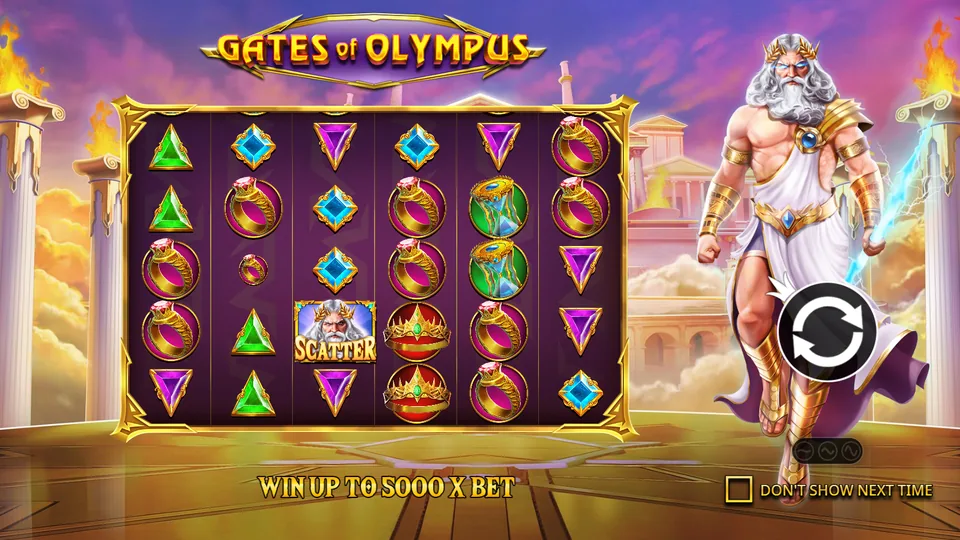
Gates of Olympus arrived from Pragmatic Play in 2021 and turned into the model for a long run of scatter pays releases. Zeus hovers next to a grid that is six reels wide and five rows deep. He does not pay anything himself; his role is to throw multiplier orbs onto the screen while the symbols do the counting.
What keeps the game popular is how little there is to memorise. You will not find paylines, a wild or a pick-and-click side feature. A win happens when one symbol shows up eight or more times anywhere on the grid, and the large payouts come from orbs landing on a chain of tumbling wins. That simple core is the reason Pragmatic built the 1000, Super Scatter and 2500 versions on top of it.
All the money examples below are worked in rand, mostly at R2 and R5 per spin, so you can picture what each rule means for a real session budget, whether that is pocket money before month-end or a set amount you put aside for the weekend.
From button press to payout
Each spin is resolved in the same fixed order. Once you know it, the animations stop feeling random.
- Thirty symbols drop in. The 6x5 grid is filled from top to bottom.
- The game counts. This is a scatter pays system, so any eight or more copies of one symbol win, wherever they land, with no need to be neighbours.
- Winners explode. The paying symbols are removed and everything above slides down, with fresh symbols filling the gaps. That is the tumble feature, and it keeps running for as long as new wins appear.
- Orbs wait. Any multiplier orb that drops during this chain stays parked on the grid until the tumbling is over.
- Payment. All wins in the chain are totalled, any orb values are summed, and that sum multiplies the chain total.
Keep one condition in mind: orbs need a win to work on. If a x500 orb lands on a spin where no symbol reaches eight, it simply disappears with nothing paid.
Symbol values at a R5 stake
Nine symbols pay. Five gems in blue, green, yellow, purple and red form the cheaper group, while the chalice, ring, hourglass and crown make up the premium group. Each value below is a multiple of your total bet, and the brackets show what that means when you spin for R5.
| Symbol | Eight or nine | Ten or eleven | Twelve plus |
|---|---|---|---|
| Crown | 10x (R50) | 25x (R125) | 50x (R250) |
| Hourglass | 2.5x (R12.50) | 10x (R50) | 25x (R125) |
| Ring | 2x (R10) | 5x (R25) | 15x (R75) |
| Chalice | 1.5x (R7.50) | 2x (R10) | 12x (R60) |
| Red gem | 1x (R5) | 1.5x (R7.50) | 10x (R50) |
| Purple gem | 0.8x (R4) | 1.2x (R6) | 8x (R40) |
| Yellow gem | 0.5x (R2.50) | 1x (R5) | 5x (R25) |
| Green gem | 0.4x (R2) | 0.9x (R4.50) | 4x (R20) |
| Blue gem | 0.25x (R1.25) | 0.75x (R3.75) | 2x (R10) |
Read the bottom rows carefully. Eight blue gems at R5 return R1.25, a quarter of what you paid, so plenty of "wins" in the base game are really partial refunds. The interesting column is the last one: a red gem jumps from R7.50 to R50 when the count reaches twelve, and tumbles are the usual way to get there, because new symbols can top up a count that has already paid once. The crown is the only symbol that returns a meaningful amount at the minimum count, R50 for eight of them at a R5 bet.
Orb maths without the guesswork
Orbs show values between x2 and x500, and they can land in the base game as well as in free spins. The rule players most often get wrong is that orbs are summed, never multiplied by each other. Our guide to multipliers compares the two systems; here is how it looks in rand.
Say you spin for R5 and eight hourglasses pay R12.50. Nothing else connects after the tumble, but three orbs dropped along the way: x3, x8 and x4. Added together they make x15, so the chain pays R12.50 x 15 = R187.50. Had the orbs multiplied one another, the result would have been x96. That gap explains why this game can feel less explosive than the orb graphics suggest.
The flip side is that big orbs often land on small wins. A x100 orb on eight blue gems at R5 turns R1.25 into R125. Pleasant, but far below what the x100 label suggests. The size of a payout always depends on the win underneath as much as on the orb.
Fifteen free spins and a multiplier that sticks
Land four or more scatters anywhere and the free spins feature starts with 15 spins. The scatters also pay on the trigger: four give 3x, five give 5x and six give 100x your bet, so R6, R10 or R200 at a R2 stake. During the round, three or more scatters award 5 extra spins.
The bonus is built around a running total multiplier. Every orb that lands in a winning chain joins the total, and the total never resets until the round ends. There is a condition, though: the stored total only boosts a winning chain if that chain also collects a new orb of its own. Any win without a new orb pays its plain value.
A round played at R2 per spin
- Spin 1: the chain wins R6 and orbs of x4 and x6 appear. The total starts at x10, so the chain pays R6 x 10 = R60.
- Spin 4: the chain wins R3 but no orb lands. The x10 total sits unused and you receive R3.
- Spin 6: the chain wins R2.50 together with a x8 orb. The total moves to x18 and the chain pays R2.50 x 18 = R45.
- Spin 11: the chain wins only R1, but a x25 orb drops. The total reaches x43 and that small R1 win becomes R43.
Those four chains add up to R151, plus whatever the scatters paid on entry. Spin 11 shows the upside: once the total is large, a tiny win plus any fresh orb pays the whole stack. The danger is just as clear. If the opening spins bring orbs only on losing chains, the stored figure stays small and the bonus may close with a handful of rand. That spread between flat bonuses and huge ones is what high volatility looks like in practice.
Paying extra per spin or buying the round
The Ante Bet raises the price of each spin by 25% and doubles your chance of landing free spins naturally. A R5 bet costs R6.25 with it switched on. Over 200 spins that is R1,250 instead of R1,000, so you are paying R250 extra for a higher trigger rate. It makes sense if you would rather see more bonuses and fewer dead base game spins.
The bonus buy charges 100x your bet and sends you straight into free spins. At R5 that is R500 for a single round, the same money as 100 normal spins. A bought bonus can return far less than its price, so treat it as one big bet. Whether you even see the buy and Ante Bet comes down to the operator and the jurisdiction.
Return builds, swings and the top prize
The default RTP is 96.50%. Operators may instead load builds at 95.51% or 94.51%; the reels look identical either way. The rules screen prints the theoretical return, and that is the only reliable place to check it. Two percentage points sounds small, yet over a few thousand spins it adds up to real money.
Volatility is high. Long sequences of small gem wins and orbs landing on blank spins are normal, broken by the occasional chain where premium symbols and several orbs line up. The maximum payout is 5,000x your bet, which means R10,000 at R2 or R25,000 at R5. Nothing, not even a pile of orbs on a long tumble, pays past that cap.
Original versus the newer Olympus editions
All later releases hold on to the grid, the scatter pays rule and tumbles, and mostly move the ceiling. Gates of Olympus 1000 stretches the orb range to x1000 and raises the cap to 15,000x. Super Scatter brings special scatters that can award instant prizes worth as much as 50,000x. The newest, Gates of Olympus 2500, pushes orbs as high as x2500 and uses a wheel to choose between four free spin modes. The 2021 original remains the most contained of the lot, which suits players who want fewer extreme outcomes and rules they can learn during one braai.
Demo drills and the local legal picture
Under the National Gambling Act of 2004, online casino games are not authorised in South Africa; the only legal online betting is sports betting with provincially licensed bookmakers. We do not encourage anyone to break local law, and we never suggest VPNs or ways around blocks. The free demo uses play credits only, and it is the right way to learn this slot. Real-money play anywhere is strictly 18+.
- Start with the rules screen. Check the return build (96.50%, 95.51% or 94.51%), the stake limits and whether the operator offers Ante Bet and the buy.
- Log orb landings. For 200 demo spins, note how many orbs fall on losing spins versus winning chains. It explains quickly why base game orbs rarely pay much.
- Measure the wait. Count spins between natural triggers and set that spend against the R500 a buy costs at R5.
- Size the stake for the swings. Choose a bet that lets your budget cover a few hundred spins rather than a few dozen.
- Decide on a stop point. Fix a limit before the first spin and keep to it whatever the last bonus did. Demo sessions also use little data, so they are easy to run on a phone during load-shedding.
Gates of Olympus: all versions compared
| Version | Released | Max win | RTP | Pays | Feature buy |
|---|---|---|---|---|---|
| Gates of Olympus (this page) | 2021 | 5,000x | 96.50% | Pays anywhere, 8 or more | 100x |
| Gates of Olympus 1000 | 2024 | 15,000x | 96.50% | Pays anywhere, 8 or more | 100x |
Where Gates of Olympus is offered

Questions from South African readers
What RTP does Gates of Olympus use?
The default build returns 96.50%. Some operators choose 95.51% or 94.51% versions, which play and look the same. The rules screen inside the game shows which build is loaded, so check it before staking anything.
Are the orb multipliers added or multiplied?
Added. Orbs from x2 to x500 that land during one tumble chain are summed, and the total multiplies the chain win. Orbs x3, x8 and x4 make x15, so a R12.50 chain pays R187.50. Without a win the orbs pay nothing.
How do I trigger the free spins?
Four or more scatters anywhere on the grid start 15 free spins. On the trigger they pay 3x, 5x or 100x your bet for four, five or six scatters, which is R6, R10 or R200 at R2. Three scatters inside the round add 5 spins.
Does the multiplier reset between free spins?
No. Each orb from a winning chain joins a running total that lasts for the whole bonus. The stored figure boosts a later win only if that chain picks up a fresh orb too; otherwise the win pays its normal value.
What is the biggest possible win?
Wins are capped at 5,000x your bet, which is R10,000 at R2 or R25,000 at R5. The 1000 edition goes to 15,000x, Super Scatter to 50,000x and the 2500 version to 25,000x.
What do Ante Bet and the bonus buy cost in rand?
Ante Bet adds 25% per spin, so R5 becomes R6.25, and doubles the free spins trigger chance. The bonus buy costs 100x your bet, R500 at a R5 stake. Availability depends on the operator and jurisdiction.
Does Gates of Olympus have a wild symbol?
There is no wild. Every win needs eight or more copies of one symbol somewhere on the 6x5 grid, and tumbles give the chain extra chances to push a count into the 10 to 11 or 12 plus bracket.