On this page
- Why Gates of Olympus is on every Indian lobby
- What happens during one spin
- Symbols and the paytable
- How the multiplier orbs add up
- Free spins and the running multiplier
- Ante Bet and the 100x bonus buy in rupees
- RTP builds, volatility and the 5,000x cap
- The original versus the newer editions
- Testing it in the demo before real play
- Gates of Olympus free demo
- Frequently asked questions
Why Gates of Olympus is on every Indian lobby
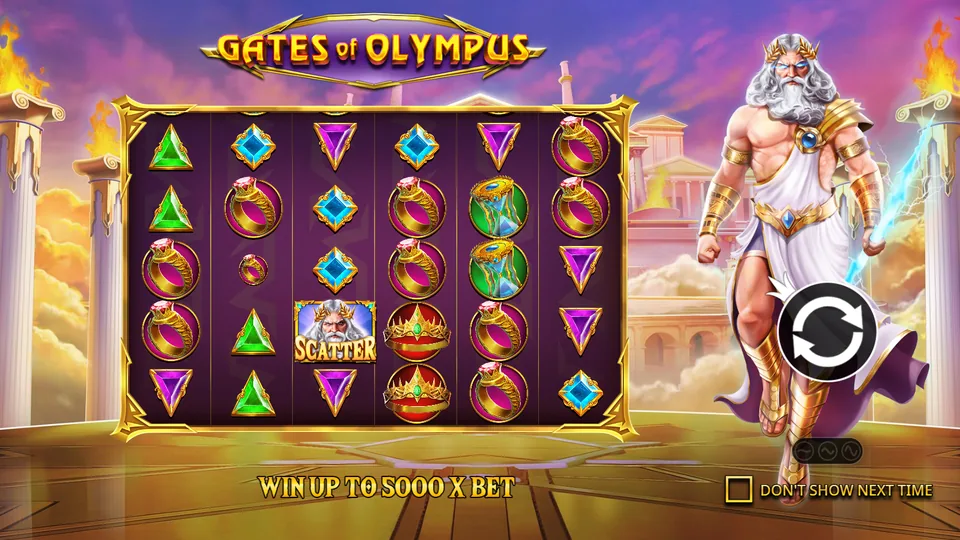
Pragmatic Play launched Gates of Olympus in February 2021, and the game went on to shape a whole generation of scatter pays titles. If you open the slots section of almost any online casino that accepts players from India, Zeus is usually somewhere near the top. The reason is not the Greek theme. It is how little you need to learn before the first spin: a 6 reel, 5 row grid, one rule for wins, one rule for multipliers and one bonus round.
There are no paylines to track and no wild symbol. Wins come from symbol counts, the tumble keeps a spin going after each win, and the orbs Zeus throws decide whether a result stays small or turns into something serious. That same core carries through the 1000, Super Scatter and 2500 editions, which change the numbers but keep the structure.
A quick word on the legal side. Gambling rules in India are set largely at state level and they differ from one state to another, so check what applies where you live before playing for real money. Real money play is for adults aged 18 and over only.
What happens during one spin
Each spin runs through the same five stages. Once you can name them, the animation stops looking random.
- Thirty symbols land. The 6x5 grid fills from top to bottom.
- The game counts each symbol. This is scatter pays: 8 or more copies of one symbol anywhere on the grid make a win. They do not need to touch and they do not need to sit on a line.
- Winners explode and the grid tumbles. Paid symbols disappear, the rest drop down and fresh symbols fall in from above. The tumble repeats as long as a new win appears.
- Orbs wait on the grid. Any multiplier orb that lands during the chain stays put until the tumbling ends.
- The chain is settled. All wins in the chain are summed. If orbs are present, their values are added together and that total multiplies the chain.
The rule that trips people up: an orb only pays if the chain it belongs to produced a win. A x500 orb on a spin with no win is pure decoration.
Symbols and the paytable
Nine symbols pay. The five gems (blue, green, yellow, purple and red) form the lower tier. The chalice, ring, hourglass and crown form the premium tier. Values are multiples of your total bet, split into three count bands. The rupee column shows what each band pays for the top count at a ₹100 stake.
| Symbol | 8 to 9 | 10 to 11 | 12 to 30 | 12+ at ₹100 |
|---|---|---|---|---|
| Crown | 10x | 25x | 50x | ₹5,000 |
| Hourglass | 2.5x | 10x | 25x | ₹2,500 |
| Ring | 2x | 5x | 15x | ₹1,500 |
| Chalice | 1.5x | 2x | 12x | ₹1,200 |
| Red gem | 1x | 1.5x | 10x | ₹1,000 |
| Purple gem | 0.8x | 1.2x | 8x | ₹800 |
| Yellow gem | 0.5x | 1x | 5x | ₹500 |
| Green gem | 0.4x | 0.9x | 4x | ₹400 |
| Blue gem | 0.25x | 0.75x | 2x | ₹200 |
Look at the step between the middle band and 12+. A red gem group pays 1.5x at ten or eleven symbols and 10x at twelve, so two extra gems turn ₹150 into ₹1,000 at a ₹100 stake. Tumbles are how you get there, because fresh symbols can add to a count that has already paid once. At the other end, eight blue gems return just ₹25 on a ₹100 spin, which is why many base game wins feel smaller than the stake.
How the multiplier orbs add up
Orbs show values from x2 to x500 and can land in the base game or in free spins. Their values are added, never multiplied by each other. Our multipliers guide compares additive and multiplicative systems; here is what it means in rupees.
Say you play at ₹100 and a chain of two tumbles pays ₹300 in total. Three orbs land: x5, x10 and x2. Added together that is x17, so the chain pays ₹300 x 17 = ₹5,100. If those orbs had multiplied each other you would see x100, which is why the real result is often smaller than the orb values suggest. The benefit is predictability: two x10 orbs always give x20.
The classic near miss is a big orb sitting on a tiny win. A x100 orb on eight blue gems at ₹100 pays ₹25 x 100 = ₹2,500. A good hit, but nothing like the number glowing on the orb.
Free spins and the running multiplier
Four or more scatters anywhere on the grid start the free spins round. The scatters pay on their own as well: 4 pay 3x, 5 pay 5x and 6 pay 100x your bet. At ₹100 that is ₹300, ₹500 or ₹10,000 before the first free spin. You receive 15 free spins, and 3 or more scatters during the round add 5 more.
The round is built around a total multiplier. Every orb that lands on a winning chain is added to a running total that stays until the round ends. Each later winning chain is multiplied by the whole total, not just by the orbs of that spin.
Worked example at a ₹50 stake
- Spin 3: a chain wins ₹200 and orbs of x5 and x10 land. The total becomes x15, so the chain pays ₹200 x 15 = ₹3,000.
- Spin 7: a chain wins ₹100 with a single x3 orb. The total rises to x18 and the chain pays ₹100 x 18 = ₹1,800.
- Spin 11: a chain wins ₹75 with no orb at all. The x18 total still applies, so it pays ₹1,350.
Together those three spins return ₹6,150, which is 123 times the ₹50 stake. Spin 11 shows how the round snowballs: once the total is built, even plain wins are boosted. The flip side is just as real. If the early orbs land on dead spins, the total stays low and the round can close with a few small wins worth less than you would like. That wide spread is what high volatility looks like in practice.
Ante Bet and the 100x bonus buy in rupees
The Ante Bet adds 25% to the cost of each spin and doubles your chance of triggering free spins. A ₹40 base bet becomes ₹50 per spin. The extra ₹10 is the price of more frequent bonus triggers, so it fits players who would rather spend less time in the base game and accept a higher cost per spin.
The bonus buy costs 100x your bet and sends you straight into free spins. At ₹20 that is ₹2,000; at ₹100 it is ₹10,000 per purchase. Before pressing it, work out how many normal spins the same amount would fund. ₹2,000 covers 100 spins at ₹20, and you have to decide whether one guaranteed bonus beats a longer session with a chance of a natural trigger. Whether the buy is offered at all depends on the operator.
| Option | Cost at ₹20 bet | Cost at ₹100 bet | What changes |
|---|---|---|---|
| Normal spin | ₹20 | ₹100 | Standard trigger rate |
| Ante Bet | ₹25 | ₹125 | Free spins chance doubled |
| Bonus buy | ₹2,000 | ₹10,000 | Instant 15 free spins |
RTP builds, volatility and the 5,000x cap
The default RTP is 96.50%, but operators may run builds set to 95.51% or 94.51%. All three look exactly the same on screen. The only place to see which one you are playing is the rules screen, where the theoretical return is printed. Across thousands of spins a two point gap is real money: on ₹1,00,000 of total bets it is roughly ₹2,000 of expected return.
Volatility is high. Expect long runs of small gem wins and orbs falling on dead spins, broken by the occasional chain where a crown group meets a stack of orbs. The maximum win is 5,000x your bet, which works out to ₹5,00,000 at a ₹100 stake. No combination of orbs and tumbles can pay beyond that.
The original versus the newer editions
All later versions keep the 6x5 grid, scatter pays and tumbles, and move the ceiling. Gates of Olympus 1000 stretches orbs to x1000 and the cap to 15,000x. The Super Scatter edition adds special scatters with instant prizes up to 50,000x. Gates of Olympus 2500 pushes orbs to x2500 and adds several free spin modes chosen by a wheel. The original keeps the lowest ceiling, which suits players who prefer fewer extreme swings and rules they can learn in a few minutes.
Testing it in the demo before real play
- Start with the rules screen. Note the RTP build (96.50%, 95.51% or 94.51%), the bet limits in rupees and whether Ante Bet and the buy are available.
- Track orb timing. Count how often orbs land on dead spins versus winning chains. It explains why base game orbs rarely pay big.
- Measure the natural trigger. Note how many spins it takes to reach free spins, then compare that spend with the 100x price.
- Size the stake to the budget. Choose a bet that lets your budget last a few hundred spins. With ₹5,000 set aside, that points to roughly ₹10 to ₹20 per spin rather than ₹100.
- Fix a stop point. Decide in advance when you will close the session, up or down, and keep to it.
Where Gates of Olympus is offered for real money

Frequently asked questions
What is the RTP of Gates of Olympus?
The default build returns 96.50%. Operators may also run 95.51% or 94.51% versions, which look identical on screen. Open the game rules before you start to see which build that site is using.
How do the multiplier orbs work?
Orbs from x2 to x500 can land on any spin. Their values are added together and applied to the whole tumble chain, but only when that chain has a win. At ₹100, orbs of x5, x10 and x2 turn a ₹300 chain into ₹5,100.
How do I trigger free spins in Gates of Olympus?
Land 4 or more scatters anywhere on the grid for 15 free spins. The scatters also pay 3x, 5x or 100x for 4, 5 or 6 symbols, so ₹300, ₹500 or ₹10,000 at a ₹100 bet. Three scatters in the round add 5 spins.
Does the multiplier reset during free spins?
No. In the bonus, every orb that lands on a winning chain is added to a total multiplier that stays for the rest of the round and applies to every later winning chain.
What is the maximum win in rupees?
The cap is 5,000x your bet. At ₹10 that is ₹50,000 and at ₹100 it is ₹5,00,000. The 1000, Super Scatter and 2500 editions raise the cap to 15,000x, 50,000x and 25,000x.
How much does the bonus buy cost?
It costs 100x your bet, so ₹2,000 at a ₹20 stake or ₹10,000 at ₹100, and starts free spins directly. Ante Bet is the cheaper alternative: 25% more per spin for double the trigger chance.
Is Gates of Olympus legal to play in India?
Gambling law in India is mostly decided by each state, and the rules differ across the country. Check the position in your state before playing for real money, and remember that real money play is for 18+ only.