On this page
- A fruit slot without paylines
- How R4 a spin is priced
- Spin, match, tumble, repeat
- Fruit pays at a R4 stake
- Multipliers that multiply
- Ten free spins, x4 tags and retriggers
- Rand examples from the bonus
- The 100x buy and the missing ante
- Return, volatility and the 5,000x ceiling
- Fruit Party, Sugar Rush and the sequel
- Demo practice and the legal position
- Fruit Party demo for free
- Questions from South African readers
A fruit slot without paylines
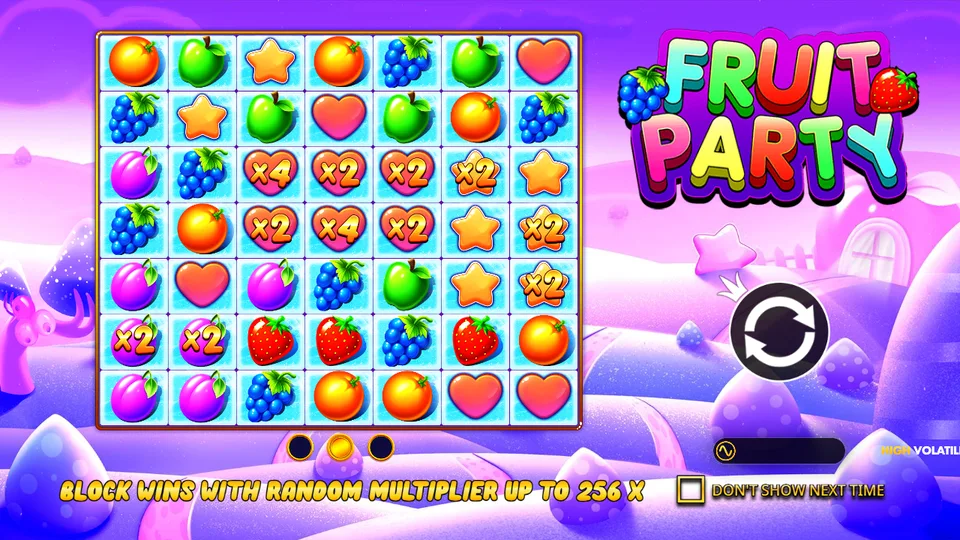
Pragmatic Play put Fruit Party out on 27 May 2020, timed as a summer release. The theme could not be more traditional: shiny fruit, bright colours, a party mood. The way it pays is anything but traditional. A 7x7 grid holds 49 positions and there are no lines at all. Fruit pays when it forms a connected block of at least five, winners vanish and new fruit falls into the gaps, and every fruit in a winning block may be carrying a concealed multiplier.
Pragmatic labels the game high volatility. In practice, plenty of spins return less than the stake, and then one block with the right tags pays hundreds of times its face value. If you have played Sugar Rush, the grid and the tumbles will feel familiar, but the multiplier logic is completely different, and that difference is the main thing this page explains.
How R4 a spin is priced
Every spin is worth 20 coins, so the total stake equals twenty times the coin value. Throughout this page we use a coin value of R0.20, which gives a spin of R4. All paytable figures are multiples of the total stake, so at R4 they convert simply. The actual coin values and limits available in rand depend on how a platform has set up the game, and they appear in the rules screen; the provider data we hold does not fix a bet range.
R4 a spin is a sensible test size: a R400 balance covers a hundred spins, a R1,000 balance about two hundred and fifty. With a high volatility slot, it pays to think in spin counts like that rather than in rand alone.
Spin, match, tumble, repeat
- Forty-nine fruits drop into seven columns.
- The game looks for groups of five or more identical fruits that are joined to one another. This is cluster pays, and block size drives the prize.
- Any fruit inside a winning block can carry a multiplier tag. In the base game tags are always x2.
- When one block contains several tags, their values are multiplied together and the result is applied to that block.
- Winning fruits disappear, the rest slide down and fresh fruit fills the top. This tumble loop runs as long as new blocks keep forming.
- Once a drop produces no block, the spin pays out and ends.
Fruit pays at a R4 stake
Seven regular fruits pay, plus the Golden Fruit scatter. Every block size from 5 to 15 has its own value, and blocks of 15 or more pay the top figure. Pragmatic does not publish the fruit names in its data, so the table ranks them from best to lowest; the in-game paytable pairs each row with its artwork and fills in the sizes skipped here.
| Rank | 5 fruits | 8 fruits | 10 fruits | 12 fruits | 13 fruits | 14 fruits | 15 or more |
|---|---|---|---|---|---|---|---|
| Best fruit | R4 | R8 | R20 | R60 | R140 | R280 | R600 |
| Second | R3 | R6 | R16 | R50 | R120 | R240 | R400 |
| Third | R2 | R5 | R12 | R40 | R100 | R200 | R360 |
| Fourth | R1.60 | R4 | R8 | R20 | R80 | R160 | R320 |
| Fifth | R1.20 | R3 | R6 | R14 | R60 | R120 | R240 |
| Sixth | R1 | R2 | R5 | R12 | R40 | R80 | R160 |
| Lowest fruit | R0.80 | R1.60 | R4 | R10 | R20 | R40 | R80 |
Two patterns stand out. Small blocks rarely cover the stake: five of the lowest fruit return R0.80 on a R4 spin. At the other end the curve is steep, with the best fruit going from R60 at twelve to R140 at thirteen and R280 at fourteen. The Golden Fruit pays nothing itself; it exists only to open the bonus.
Multipliers that multiply
Most slots that put several multipliers on one win add them together. Fruit Party multiplies them, which changes the maths dramatically. Our multipliers guide covers the general types; these are the specific rules here.
- Tags only appear on fruits that are part of a winning block, never on their own.
- Base game tags are worth x2. During free spins they turn up more often and can be x2 or x4.
- Tags inside one block multiply: two x2 tags give x4, three give x8, four give x16.
- The combined value on any single block cannot exceed x256.
Base game example at R4 a spin. A block of ten best fruits is worth R20. Three of its fruits carry x2 tags, so the block multiplier is x8 (two times two times two) and the payout R160. Had those tags been added instead, the block would get x6 and pay R120. The gap grows quickly with more tags: five x2 tags compound to x32, while added together they would come to x10.
This is where it parts ways with Sugar Rush. There, multipliers live on grid positions and are summed when a cluster covers several of them. Here the multiplier sits on the fruit itself and compounds within the block.
Ten free spins, x4 tags and retriggers
The bonus needs three or more Golden Fruit scatters, in any position, and it opens with 10 free spins. Two things change once the round starts: winning fruit picks up tags more often, and a tag can now be x4 as well as x2. If three to seven scatters land again during the round, you receive 10 to 14 extra spins, depending on the number of scatters.
A ten spin round is short. Most of its value tends to arrive in one or two blocks loaded with tags, not through a slow build, so a round can feel quiet for eight spins and then pay most of its total on the ninth.
Rand examples from the bonus
Stay at R4 a spin.
- Thirteen fruits of the third rank with tags of x4 and x2. The block is worth R100 on its own. The tags compound to x8, so it pays R800.
- Twelve fruits of the fourth rank with three x4 tags. R20 multiplied by 4 x 4 x 4 = x64 gives R1,280.
- Eight best fruits with four x4 tags. R8 times x256 equals R2,048. This block has hit the x256 limit, so a fifth tag would add nothing more.
- A block of 15 or more best fruits at x256. R600 multiplied by 256 would be R153,600, far beyond the game's cap. The payout stops at 5,000 times the stake, R20,000 at R4.
The last line shows that the cap is a real ceiling here, not a theoretical one. Most rounds finish nowhere near it, but when big blocks and stacked tags meet, the cap is what decides the final number.
The 100x buy and the missing ante
Where the operator's licence allows it, a bonus buy sends you straight to the 10 free spins for 100 times your stake: R400 at R4, R1,000 at R10. A purchased round can pay a multiple of its price or a small fraction of it, and the second outcome is common. At R4 a spin, fifty buys would cost R20,000, exactly the most a single win can pay, which puts the button in perspective. If you use it, settle the number of buys before the first one and stop there.
You will not find an ante bet in Fruit Party. The price per spin never changes from 20 coins, so the only way into the bonus without buying is to wait for the scatters.
Return, volatility and the 5,000x ceiling
Pragmatic's game page gives an RTP of 96.50%. The demo build we loaded straight from Pragmatic's own server reported 96.47%, a reminder that the version in front of you may differ from the headline. On R1,000 of total spins, 96.50% means about R965 back on average over the long run. Volatility is high and the top win is 5,000 times the stake.
Before any real stake, read three lines in the rules screen: the RTP figure, the bet limits in rand, and how the maximum win is worded. Those tell you more about the build you are actually loading than any figure printed elsewhere.
Fruit Party, Sugar Rush and the sequel
| Point | Sugar Rush | Fruit Party |
|---|---|---|
| Grid | 7x7 clusters | 7x7 clusters |
| Where multipliers sit | on grid spots | on winning fruits |
| How several combine | added | multiplied |
| Cap and buy price | 5,000x and 100x | 5,000x and 100x |
Pragmatic followed up with Fruit Party 2 on 5 August 2021. The sequel keeps clusters, tumbles and Golden Fruit scatters but moves multipliers onto random wilds: in the base game wild multipliers add up across winning clusters to x256, and in free spins one wild can reach x729. The original remains the simpler game, with no wilds and a single rule for tags.
Demo practice and the legal position
The free demo plays the full game on play credits. Spend two or three hundred base spins tallying the share of winning blocks that show a tag, and how often a block reaches ten fruits, the point where payouts start to grow. Then make a few demo buys and set each result against the 100x price. Then check the RTP line in the rules.
A note for readers at home: under the National Gambling Act 2004, online casino games are not authorised in South Africa, and online betting is legal only as sports betting with bookmakers licensed by a province. We do not encourage breaking local law and never recommend VPNs or ways around blocks. This page is for adults aged 18 and over.
Wherever you play lawfully, set a stake that survives several hundred spins and a firm stop point. A high volatility slot can sit below the starting balance for a long time while behaving exactly as designed.
Where Fruit Party is offered

Questions from South African readers
What RTP does Fruit Party have?
Pragmatic Play's official game page states 96.50%. The demo build we loaded showed 96.47%, which proves that an operator's version need not match the headline figure. The rules screen of the game you open shows the exact value.
How do Fruit Party multipliers combine?
Tags sit on fruits inside winning blocks. In the base game they are x2, in free spins x2 or x4. Several tags in the same block multiply, so x2 and x4 together make x8, with a ceiling of x256 for one block.
How many free spins can I get?
Three or more Golden Fruit scatters start 10 free spins. A fresh landing of three to seven scatters inside the feature tops it up by 10 to 14 spins, and tags become more frequent and can reach x4.
What is the most Fruit Party can pay at R4 a spin?
The cap is 5,000 times the stake, which is R20,000 at R4. Even a full block with a x256 multiplier is cut off at that figure.
How much does the bonus buy cost?
Where it is allowed, the buy costs 100 times the stake and starts the standard 10 free spins at once. At R4 that is R400. Fruit Party has no ante bet option.
How many matching fruits make a win?
At least five identical fruits joined together in one connected group. Bigger groups are worth far more, with blocks of 15 and above earning the top value, which for the best fruit is 150 times the stake.
What separates Fruit Party from Sugar Rush?
They share a 7x7 cluster grid, tumbling wins, a 100x buy price and a cap of 5,000x. Sugar Rush puts multipliers on grid spots and adds them, while Fruit Party attaches them to winning fruits and multiplies them.