On this page
- How Sugar Rush works
- A spin step by step
- Symbols and paytable
- Spot multipliers explained
- Free spins and sticky marks
- Bonus buy cost and what it changes
- RTP, volatility and max win
- Sugar Rush versus its newer editions
- Who Sugar Rush suits
- How to test it in the demo
- Sugar Rush free demo
- Sugar Rush: all editions compared
- Frequently asked questions
How Sugar Rush works
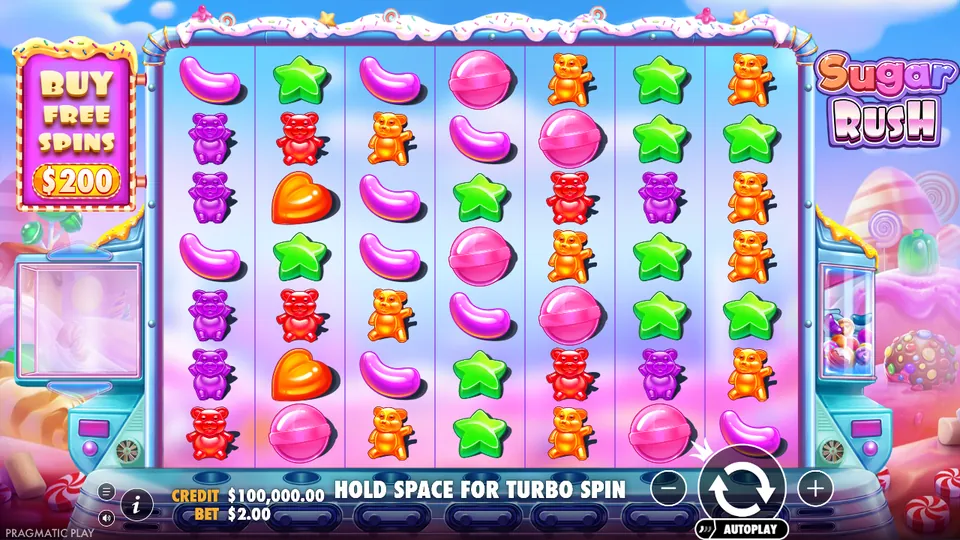
Sugar Rush drops 49 sweets onto a 7x7 grid and pays for groups, not lines. Five or more identical symbols that touch horizontally or vertically form a winning cluster. Diagonal contact does not count, which is the single most common misreading for players arriving from line slots. If you want the wider picture of how cluster pays compare with paylines and ways, our paylines, ways and clusters guide covers it.
Every cluster win triggers a tumble: the winning sweets vanish, the symbols above fall into the gaps and fresh ones drop in from the top. If the new layout forms another cluster, it pays and the process repeats. One paid spin can therefore produce a chain of several wins before the grid settles.
A spin step by step
- Place your stake. Every payout in the paytable is a multiple of your total bet, so the numbers below scale directly with your stake.
- The grid lands. The game scans for clusters of 5 or more matching sweets connected edge to edge.
- Wins pay and spots get marked. Each cell that was part of a winning cluster receives a mark.
- Tumble. Winners disappear, symbols fall, new ones fill the grid.
- Multipliers appear. If a new winning cluster lands on a marked cell, that cell turns into a x2 multiplier. Each further win on it doubles the value.
- Chain ends. When no cluster forms, the spin is over. In the base game all marks and multipliers are then wiped.
Symbols and paytable
There are seven paying sweets. Four are candies, three are gummy bears, and the bears sit at the bottom of the table. The scatter, a rocket with candy balls, can land on any reel but pays nothing by itself: its job is to start the bonus. The table shows payouts in multiples of your total bet for four key cluster sizes; the in-game paytable lists every size in between.
| Symbol | 5 | 8 | 12 | 15+ |
|---|---|---|---|---|
| Pink lollipop | 1x | 2x | 15x | 150x |
| Orange heart | 0.75x | 1.5x | 12.5x | 100x |
| Purple candy | 0.5x | 1.25x | 10x | 60x |
| Green star | 0.4x | 1x | 5x | 40x |
| Red bear | 0.3x | 0.75x | 3.5x | 30x |
| Purple bear | 0.25x | 0.5x | 3x | 25x |
| Orange bear | 0.2x | 0.4x | 2.5x | 20x |
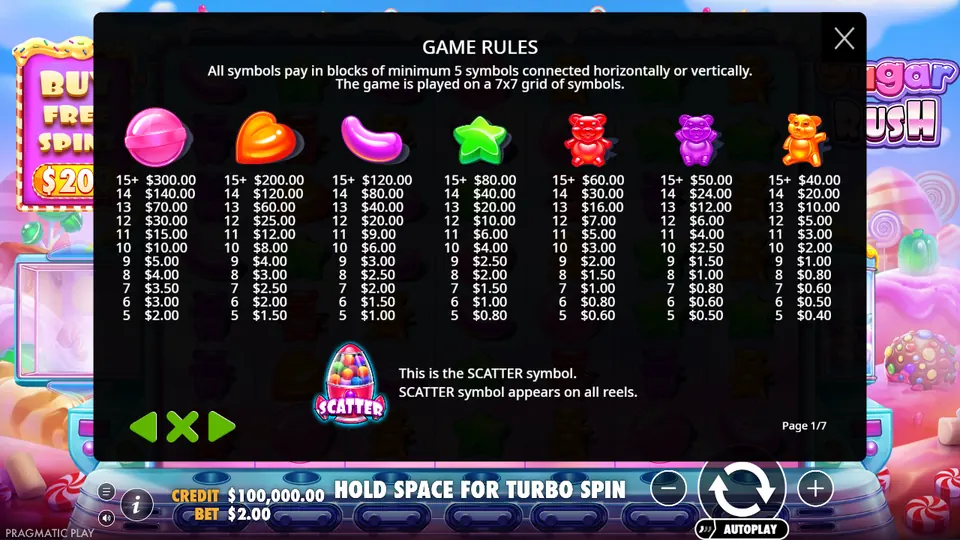
Read the jumps carefully. A lollipop cluster pays 1x at five symbols but 15x at twelve, a fifteenfold increase for seven extra sweets. Small clusters of bears barely return a fraction of your bet; the real value sits in big clusters and in the multipliers they land on.
Spot multipliers explained
This is the heart of the game and the reason it plays differently from most tumble slots. Our multipliers guide covers the general types; here is exactly how Sugar Rush handles them.
- The first win on a cell only marks it. No multiplier yet.
- The second win on the same cell creates a x2 multiplier.
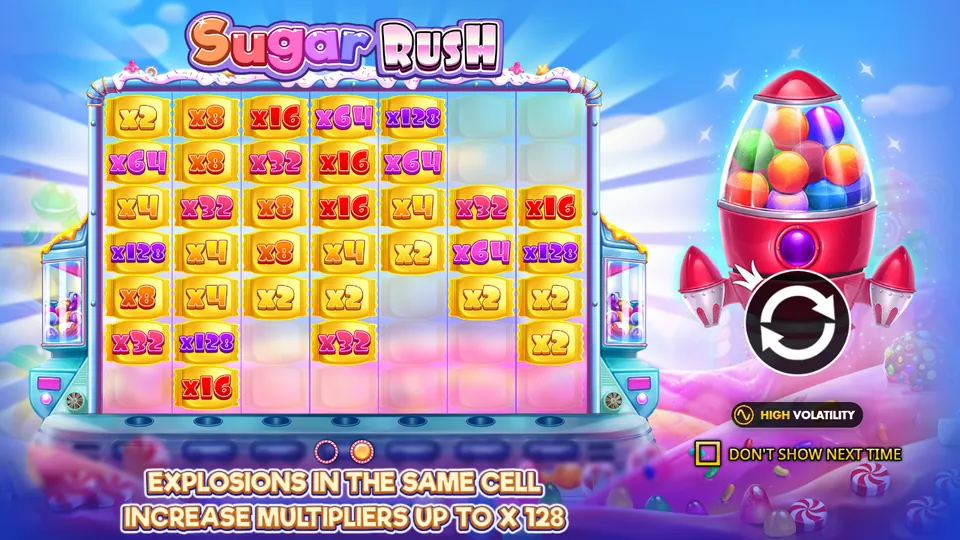
- Each further win there doubles it: x4, x8, x16, x32, x64, up to a ceiling of x128.
- If one winning cluster covers several multiplier cells, their values are added, not multiplied, and the total applies to that cluster's payout.
Worked base game example at a 1.00 stake. The first tumble pays a cluster of 8 red bears for 0.75 and marks those eight cells. The next tumble drops a cluster of 8 green stars that overlaps three of the marked cells. Those three become x2 each, so the cluster gets x2 + x2 + x2 = x6, and 1.00 becomes 6.00. The whole spin returns 6.75. The moment the chain ends, all eight marks disappear.
That reset is why the base game feels restrained. Multipliers can build during a long tumble chain, but they cannot carry over from one paid spin to the next.
Free spins and sticky marks
Three or more scatters anywhere on the grid start the free spins round. The number of spins depends on how many scatters landed:
| Scatters | 3 | 4 | 5 | 6 | 7 |
|---|---|---|---|---|---|
| Free spins | 10 | 12 | 15 | 20 | 30 |
Scatters that land during the round add extra spins. The key difference from the base game: marked cells and their multipliers stay for the entire round. Every win adds heat to the grid, and a cell that reaches x32 in spin three is still x32 in spin ten, ready to double again.
Worked bonus example at a 0.50 stake. You trigger 12 free spins with four scatters. By spin nine, one corner of the grid holds cells at x16, x8 and x4 from earlier wins. A cluster of 12 purple candies lands across those three cells. Base pay is 10x the bet, so 5.00. The multipliers add to x16 + x8 + x4 = x28, and the win becomes 5.00 x 28 = 140.00, or 280 times your stake from a single cluster. That is how the round climbs, and it also shows why a bonus with scattered, unconnected multipliers can still end small.
Bonus buy cost and what it changes
Where the operator allows it, the bonus buy opens free spins directly for 100x your bet. At a 0.20 stake that is 20.00; at 1.00 it is 100.00. You skip the wait for scatters, but you pay the average cost of the feature up front, and a bonus that never connects its multipliers can return far less than the price. Treat it as a way to see the round, not as a shortcut to profit, and size the stake so a single buy is a small share of your session budget.
RTP, volatility and max win
The standard build returns 96.50%. Platforms can install a lower RTP version of the same game, so open the rules screen and check the figure before you play. Our RTP guide explains what the number means over a long run and why it tells you little about a single session.
The game itself labels its volatility as high. In practice that means frequent small tumble wins, long stretches without a bonus and occasional large results concentrated in free spins. The maximum win is 5,000x the stake, so 5,000.00 at a 1.00 bet.
Sugar Rush versus its newer editions
The original is the base template for the series. Sugar Rush 1000 keeps the same grid and paytable but lets spot multipliers double all the way to x1024 and raises the cap to 25,000x. Sugar Rush Super Scatter adds a large scatter symbol that can open rounds with a 50,000x ceiling. Sugar Rush Xmas is a winter reskin with the original numbers. If you want lower extremes and the cleanest version of the mechanic, the original is the one to start with.
Who Sugar Rush suits
Sugar Rush fits players who enjoy watching a board develop. The base game is mostly a stream of small cluster wins, and the interest comes from the tumble chains that occasionally line up a marked cell or two. The free spins round is where the game shows its full character: each spin leaves the grid a little stronger, and the tension builds as multipliers cluster in one area.
It is less suited to anyone who wants steady returns on every session. With high volatility, a 5,000x ceiling that is only reachable through connected multipliers, and a bonus that can arrive after hundreds of spins, results swing widely. Our volatility guide explains how to match a slot like this to your budget. As a rule of thumb, lower stakes and longer sessions give the bonus more chances to appear, while bigger stakes simply make each swing larger in both directions.
How to test it in the demo
The free demo is the best place to see how multipliers behave before you spend anything. In Sugar Rush specifically:
- Watch the marks during a long tumble chain and count how often a second win really lands on a marked cell.
- Buy the bonus a few times with demo credit to see the spread of results. A round can finish below its 100x price even with sticky multipliers.
- Open the rules screen and note the RTP, the minimum and maximum bet and whether the bonus buy is available on that platform.
- Pick a stake that gives you at least 150 to 200 spins from your budget. High volatility punishes short bankrolls.
No setting changes the odds of a spin. What you control is stake size, session length and when you stop.
Sugar Rush: all editions compared
| Edition | Release | Max win | RTP | Pays | Bonus buy |
|---|---|---|---|---|---|
| Sugar Rush (you are here) | 2022 | 5,000x | 96.50% | Cluster pays, 5+ connected | 100x |
| Sugar Rush 1000 | 2024 | 25,000x | — | Cluster pays, 5+ connected | 100x |
| Sugar Rush Super Scatter | 2025 | 50,000x | — | Cluster pays, 5+ connected | — |
| Sugar Rush Xmas | 2023 | 5,000x | 96.50% | Cluster pays, 5+ connected | 100x |
Where to play Sugar Rush for real money

Frequently asked questions
How do wins work in Sugar Rush?
Five or more identical sweets connected horizontally or vertically form a winning cluster on the 7x7 grid. Diagonal contact does not count. Winning symbols are removed, new ones tumble in and further clusters pay in the same spin.
How do the spot multipliers work?
A first win on a cell marks it. A second win there creates a x2 multiplier, and each further win doubles it up to x128. Multipliers covered by one cluster are added together and applied to that cluster's payout.
Do multipliers stay between spins?
Not in the base game: marks and multipliers reset after every paid spin. In free spins they stay for the whole round, so multipliers keep building from spin to spin.
How many free spins can I get?
Three, four, five, six or seven scatters award 10, 12, 15, 20 or 30 free spins. Extra scatters landing during the round add more spins.
What is the RTP of Sugar Rush?
The standard build returns 96.50%. Some platforms run a lower RTP version of the game, so check the exact value in the game rules before playing.
What is the max win in Sugar Rush?
The maximum win is 5,000 times your stake. At a 1.00 bet that is 5,000.00. Sugar Rush 1000 and Sugar Rush Super Scatter have higher caps.
How much does the bonus buy cost?
Where the operator offers it, the bonus buy costs 100 times your bet and starts free spins immediately. At a 0.50 stake that is 50.00. Availability depends on the platform.


 New
New